Saturday, January 18, 2020

The fall of Icarus - like Matisse


You need:
  1. dark blue construction paper
  2. black construction paper
  3. leftovers of construction paper in several colors
  4. scissors
  5. glue
In this lesson students cut a performance out of paper just like Matisse did with his work: The fall of Icarus. 
Matisse (1969-1954) was a French sculptor and painter. He is seen as the founder of fauvism. In his last years of life Matisse wasn't able to paint anymore. A pair of scissors was the tool he used to transform painted papers (painted by assistants) into a world of plants, animals, shapes and figures. 
One of these cut-outs is the artwork Icarus (1947). 

Read the myth of Daedalus and Icarus. 

Then look at the original artwerk Icarus.
What do you see? At what time of day were  Daedalus and Icarus flying and how can you see that? (at night - dark blue paper, stars). What do you notice about the body of Icarus?  (limbs have different thicknesses) What can you deduce from that? (no drawing in advance but cut out of the hand) What could be the red dot? (heart)  How do you know Icarus is falling? (arms spread, head not straight on the body) Can you see that Icarus is falling into the see? (no) What else could he fall in?

Task
The real Icarus fell into the sea, but our Icarus falls into something else ... and you  decide for yourself into what! Trees? A city? On a church?
Cut a falling human out of black construction paper.  You're not allowed to make a drawing in advance, just cut 'out of the hand'. If the first time fails, you take a new black sheet. Cut some stars. Cut a surface: in what is Icarus falling?  Place the loose parts on a blue sheet and stick all of them.

All artworks made by students of grade 3. 

Thursday, November 7, 2019

Transport - like Hundertwasser


Friedensreich Hundertwasser (1928-2000) was an Austrian artist and architect who is best known for the colorful buildings he designed, built with attention to the environment and natureThe buildings of Hundertwasser are very recognizablestraight lines are missingthere is use of bright colors and many of his buildings have typical turrets. The influence of architect Gaudi is obvious.
The paintings of Hundertwasser have exuberant colours too and mainly undulating lines.

Show buildings of Hundertwasser on the digital board. Discuss the salient  features: bright coloursundulating linesThen show some paintings and discuss the things that stand out:

 the use of small areas outlined with black
 no straight lines, usually parallel lines
 recurring spiral shapes
 bright colours

Tell students they are going to draw means of transport in the style of Hundertwasser. 

You need:
  1. drawing sheet
  2. pencil
  3. markers
Draw a car, plane, boat or something you think is a mean of transport. Fill it with lines and patterns like Hundertwasser did. Cut your drawing and paste all means of transport on a great colored sheet. 

Source: Dutch website Laat maar zien. 

Wednesday, November 6, 2019

Op art - like Henrique Matos

You need:
  1. white drawing sheet A4 size
  2. liquid water colour
  3. jar with water
  4. compasses
  5. ruler
  6. pencil
  7. black waterproof markers
Henrique José Teixeira Matos is a Portugese painter. He is born in 1961 in Oporto.  Matos painted landscapes, portraits and abstract works, but is best known for his op-art work.
Show pictures of Matos's work on Wikimedia Commons. Look especially the op-art works and discuss what you see.

More op-art lessons on this blog can be seen following the link Op-art.

Paint a white sheet of paper with liquid watercolour and a lot of water a plain background.


Drip some liquid water colour on the surface while it is still wet. Use more water if the colours won't flow. Leave the sheet to dry.


Use compasses to draw some small circles (2 cm average) on the sheet. Draw wider circkels around them. Fill the sheet with those circles and half ones near the edges.


Draw lines from the middle of the circles to the edges. Be sure it's an even number of lines and  Kkeep the lines as much as possible equidistant from each other. Color the squares alternating with a black marker or pencil.


Op art hands


You need:

  1. drawing sheet
  2. pencil
  3. ruler
  4. markers 
Draw a grid on the sheet with squares from 2 cm by 2cm. Draw your hand or an object with a pencil. Color this alternately with black an a color of your choice.  Color the background squares with the same colors, but so that the checkerboard pattern reverses.

Thursday, June 13, 2019

Where Keith Haring meets Piet Mondriaan

What do you need?
  • large drawing sheet 
  • black strips 1,5 cm wide
  • colored construction paper in red, yellow and blue
  • ruler
  • scissors
  • glue
  • black marker
This is a teamwork lesson for two students. 

What should you do?
Draw squares and rectangles of various sizes on the colored paper. Make sure they are straight: start from a right angle and measure carefully. 
Cut squares and rectangles and paste them on the white sheet. Make sure same colors do not touch each other. 
Continue with the black strips. Consider how many strips and where you want them, but there are four requirements:
  1. the strips must be sticked straight! (use your ruler)
  2. black strips must be sticked around all colored area's
  3. use the black strips to create white area's (squares and rectangles) 
  4. don't use to much glue. Let some strips stay loose so you can put a Haring figure behind it.
Draw three or more Keith Haring characters on the colored paper. Cut them and paste them on the Mondriaan sheet. Be sure there is no yellow character on a yellow area. 
Outline the characters with black marker and draw some 'move stripes' around them.

Artworks made by students of grade 6. 

Thursday, May 9, 2019

Picture book illustration


Students of grade 6 made this illustration. After a good study of the original illustration in a Dutch picturebook, they made a list of required materials to use for this artwork. The faces and arms are painted, the clothes and curtains are cut out of fabric, the wallpaper comes from a sample book for wallpaper and the flags are from scraps of paper.


Saturday, January 12, 2019

Cat on head - like Corneille


Made by a student of grade 3
You need:
  1. drawing sheet A3 size
  2. oil pastels
  3. liquid watercolor paint
  4. brushes
Corneille painted often cats, birds and women. There are some paintings where he painted the cat on the head of a woman!
Show Corneille paintings on the digital board or use google: 'Corneille woman cat'.

Who of you has a cat at home? Does it ever lie with you? Does your cat ever lie on your head?
Look at these artworks. What do you see? Why would the painter left the cat's eyes white?  Do the women on the paintings have hair? 

Draw a head on your sheet with oilpastel (dark color). Maybe your own head, but you may choose another head too. Draw a cat sitting, standing or lying down on the head. The cat looks like hair! What hairstyle it is, had to do with the position of the cat. 
Color your drawing with bright colors. Trace the outlines with a dark color if necessary and paint the background with liquid watercolor paint. 

Made by a student of grade 3

There are more lessons about Corneille on this blog! Use the search function. 

Friday, January 11, 2019

Corneille China

Made by a student of grade 1
You need:
  1. paper plates)
  2. black markers
  3. acrylic paint
  4. small brushes 
  5. jars with water and paper towels
Show some pictures of animals in Corneille's artwork. What do you see? What can you say about the colors? Do you like it? Why or why not? What animals do you see on the china?

Choose an animal. Use a black marker to draw it on your plate. You can also decide to draw just the head of the animal. Your drawing has to be large, it has to fill almost the entire plate. Can you think of anything else? Does the moon shine? Is your animal with others? Or is it in the grass? You can make it!

Color your drawing with acrylic paint and a brush. Choose bright colors and make sure it's opaque. Rinse your brush with each new color and dry it well in a paper towel; the acrylic paint shound not get wet.

Trace the marker lines again if necessary but only if the paint is really dry.

More information about Corneilla and the Cobra group on this blog:  Lesson 1 en lesson 2.

Wednesday, October 3, 2018

Collage like Karel Appel (CoBrA)

On black background, made by a student of grade 5

You need:
  1. black or white drawing sheet A3 size
  2. colored construction paper, 5 colors for each student 
  3. glue
  4. black tempera paint
  5. small brush
  6. liquid water color paint for background 
Karel Appel (1921-2006) was a Dutch expressionistic painter and sculptor, famous as one of the founders of the CoBrA movement. CoBrA stands for Copenhagen, Brussels and Amsterdam.
CoBrA artists were inspired by children's drawings and the art of mentally disturbed.

Tell your students about abstract and figurative art. Show abstract and figurative artworks and ask which word belongs to them.
Then view some of Karel Appel's works: Little Boy, Some people together, Blue faced beast and Saarbrücken (Google pictures). Are these figurative or abstract? Put your hand on the eyes of the painting. Is the artwork still figurative? Students will discover the Appel's art is very close to abstract. 

When we see Karel Appel, we discover:
  • large surfaces
  • bright colors
  • a few colors
  • thick black lines
Students tear (using two thumbs and two fingers, show well how they have to tear)  organic shapes from the construction paper.  It's absolutely not the intention to tear a human of animal. The shapes have to be 'just like that'.  Some students will smuggle a little bit and stick an eye somewhere. Then squeeze an eye :) but do not accept clearly laid human figures.

When they have torn enough pieces, students make a composition of the shapes and paste them on the black or white sheet. The pieces may also be stuck over or on top of each other. Then the most exciting part of this lesson: what do I see in my collage? Ask a classmate to keep your work up. What do you see? Turn the work 90 degrees, and again and again. Do you see an animal or a human?
Use black paint and a thin brush to draw lines on your artwork so that your human of animal is also visible to others. Not too much lines, there must be some guesswork too!

On a painted backgrond, made by student of grade 5

Tuesday, September 25, 2018

Mondriaan: from 2D into 3D

You need:
  1. white construction paper  A4 size
  2. ruler
  3. pencil
  4. colored construction paper in yellow, blue and red
  5. black marker
  6. cutting mat and cutter 
  7. glue
Show artworks of Piet Mondriaan and De Stijl and discuss them.

Fold the white sheet in 5 columns. The columns don't have the be the same width. Divide the sheet with pencil and ruler in three rows (thin, the lines have to be erased later).
Cut rectangle and squares out of colored paper. Make sure they are not wider as the columns. Paste  the rectangles and squares between the folded lines and outline them using a ruler and a black marker. Connect each one with its 'neighbour' with a marker. The lines should be horizontal or vertical.

Then cut two horizontal lines from the start of column 2 towards the end of column 4 (see picture).

Saturday, September 22, 2018

Mondriaan cube


You need:
  1. white cardboard
  2. ruler
  3. pencil
  4. cutting mat and knife
  5. markers
  6. glue
After a lesson about the work of Piet Mondriaan, students draw a template of a cube (nice goal for the math lesson!). The surfaces are 8 by 8 cm, the stick edges are 1 cm.

Cut the template with a cutting knife. Use a black fine marker to draw squares at 1/2-1 cm from the edges. Within these squares you draw straight lines to get some rectangles and squares. Color these using Mondriaan colors: red, yellow and blue. Leave some surfaces white.


Fold the stick edges and paste them to get the Mondriaan cube!


Saturday, September 15, 2018

Sawing like Piet Mondriaan


Made by a student of grade 3
You need:
  1. black construction paper
  2. plywood  
  3. ruler and pencil
  4. tempera paint in primary colors kleuren + white
  5. brush
  6. coping saw
  7. sandpaper
  8. glue
Divide a rectangular piece of thin plywood into rectangles and squares using ruler and pencil and saw them. Place every piece directly on the right spot the black construction paper. All pieces have to form a rectangle again. 

Sand the edges of pieces. Paint the pieces in primary colors and white. Past them on the black sheet. 

Thursday, September 13, 2018

Patterned trees collage

You need:
  1. white drawing sheet A3 size
  2. liquid water color paint
  3. brush
  4. construction paper in several colors
  5. scissors and glue
  6. black fine marker
Fold the sheet in two. Paint the upper half blue, the  lower half green. Leave the edges white. 
Cut several shapes from construction paper: ovals, 'clouds', circles.   
Use a fineliner to draw the trunk and fill the shapes with a variety of patterns.  
Paste the shapes on the painted sheet and be sure the shapes overlap each other to suggest depth.

Wednesday, September 12, 2018

Portfolio: Bad Hair Day

You need:
  1. white sheets
  2. liquid watercolor paint
  3. straws
  4. oil pastel crayons
How to draw a face? We used the website Wikihow. Students draw their own face on a large white sheet and color it with oil pastels. Drop liquid water color in several colors above the head and blow it in different directions using straws. 


On the photo our proud third grade students with their portfolio's in which we collected all the artwork of this school year.

Thursday, November 30, 2017

Christmas carpet


Made by a student of grade 6
You need:
  1. green, red or black construction paper  25 by 25 cm
  2. ruler
  3. pencil
  4. gold or silver marker
  5. red or green marker
Students divide their sheet with ruler and pencil in 25 squares from 5 by 5 cm. In each square they draw a Christmas figure: tree, candy, snowman, skates, mitten, sock, candle etc. These figures have to be coloured , just like a checkerboard: alternately the background is gold/silver or the figure is gold/silver.

Thursday, April 13, 2017

Letter doodling

You need:
  1. white drawing sheet A3 size
  2. ruler
  3. pencil
  4. black markers
  5. colored markers or pencils 
Shot pictures of letter doodling and fonts - new and older ones. 
Discuss the pictures. Letters in those alphabets are a kind of family.  How can you see that? What can you say about the lines? Are they fat, thin, curvy or angular? What do you feel seeing those alphabets?

Draw a grid with your students (a lesson about using rulers is always a struggle!). In this lesson there are 2 inches between the lines and a half inch between the letters.

After drawing their grid, students design their own alphabet and trace them with markers.

Artworkds made by students of grade 5

Saturday, March 4, 2017

Groupwork like Joan Miró

Made by students of grade 3/4

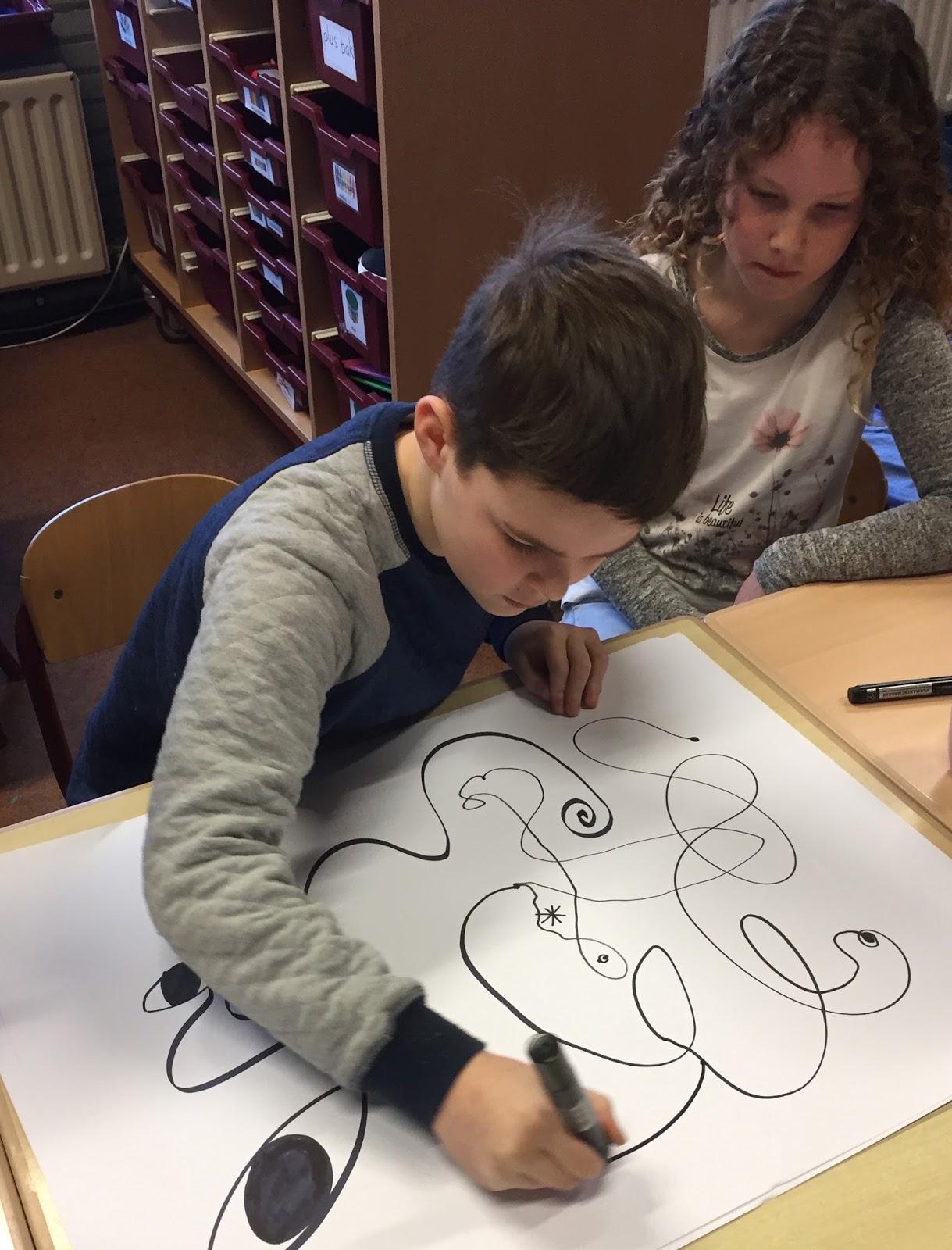
Joan Miró's (Spain, 1893-1983) made paintings, sculptures, textile arts and theater. His paintings contain colorful organic shapes in bright colors: red, blue, yellow, green. The colored surfaces are outlined in black and frequently divided with black lines.

Show some of Miró's artwork. What do you see: bright colors, eyes, shapes outlined in black, divided surfases, stars. Talk about the difference between geometric and organic shapes. Talk about lines: straight, angular, rounded. What do you see in Miró's artwork?

The goal for a group of 4 students is: draw alternately lines on the white sheet with a permanent black marker. Make sure those lines look like Miró. Off course lines may cross! Then draw some elements Miró used too: eyes, stars, divided surfaces etc. Color the artwork. Be sure you're working with 4, so consult each other.

Ready? Sign the work with your personal signature in Miró style!


Friday, March 3, 2017

Medieval guild signs


You need:
  1. several materials,  like cardboard or wood 
  2. drawing materials
In the Middle Ages in Europe many artisans and merchants were joined in a guild. A guild was a kind of union for people with the same profession. The guild proposed rules for their members and provided in the exchange of knowledge and experience.
Examples of trade guilds are baker's guild, weaver;s guild, brewers guild or carpenter guilds.
Market vendors and peddlers were members of a merchant's guild. They traded goods such as fabrics, wood and food.


After a lesson about medieval guilds, these guild signs were made. The goal was to create a guild sign on which you can see what guild you're dealing with.


Friday, December 16, 2016

Dancing Christmas trees

Made by a student of grade 1
You need:

  1. white drawing sheet
  2. pencil
  3. markers
  4. chalk pastels
Dancing Christmas trees are Christmas trees who look like them only because of the shape (rectangular) and decorations (balls, garlands and stars)! The trunks are much longer than the  the ordinary trees and because of the curves in them it looks they are dancing.  
Draw with pencil, colour with markers, outline with black marker and colour the background with chalk pastels.


Wednesday, November 30, 2016

Landscape with chalk pastels

Made by students of grade 5

You need:
  1. black construction paper
  2. black oil pastels
  3. soft pastels
  4. hairspray
Show several hillsides and discuss what you see:  light/shadow, depth, overlapping, colours, pointed/rolling. 

Students draw with pencil a simplified hillside on the black sheet. In the blogpost 'Peaks and Valleys' a step by step explanation how to draw this. Give students a maximum of 5 minutes for this part of the lesson, to prevent them of drawing all kinds of details.

Trace the pencil lines with black oil pastel. Colour the hills and sky using chalk pastels. Color and mix, smear and blend until you're satisfied. Be sure the difference can be seen between the light-iluminated parts of the hills and the parts that are in shadow. 
Trace after coloring the black lines again if necessary. Fix the artwork with hairspray. 

Monday, November 21, 2016

Tea light holder The Style

Made by a student of grade 4

You need:
  1. black construction paper  41 by 12 cm 
  2. wax paper in red, blue and yellow
  3. cutting mat and cutter
  4. glue
Tell students about art the movement The Style and two of its most famous contributors Piet Mondriaan and Theo van Doesburg. 

Draw 4 lines with 10 cm between them from bottom to the top of the black sheet. The last strip (1 cm) is the glue strip. 
Draw four squares or rectangles on the black sheet. Then draw lines from about 1 cm wide. Cut the spaces between the lines and paste wax paper behind them. 
Finish the lantern by folding the four lines and pasting it. 

Monday, November 14, 2016

Moon behind tree

Made by a student of grade 6
You need:
  1. white drawing sheet 
  2. charcoal
  3. chalk pastels 
  4. indian ink
  5. brush 
Use a saucer to draw a moon in the center of the sheet. Colour it with yellow chalk pastel. Colour the rest of the sheet grey using charcoal: around the moon it's brighter than further away.
Draw a branch and paint it with Indian ink.

Saturday, November 5, 2016

Weaving like Mondriaan

Made by a student of grade 2

You need:
  1. white sheet A4 size
  2. colored paper strips in primary colours
  3. scissors
  4. glue
  5. black fineliner 
Fold the white sheet in half.
Cut evenly-spaced slits starting from the folded edge and continuing up to about a half inch from the opposite. Open up the paper.
Take one paper strip and weave it across the slits, going over and under them. Push the strip to the top and start with another one. The second strip should be woven in an opposite pattern as the first one. If the first strip goes over and under across the slits, the second one should go under and over the slits.
Continue weaving until the white sheet is full. Paste the ends of the strips on the white sheet.
Create a frame by pasting the artwork on black construction paper. Draw small patters on the white strips using a fine black marker. 

Sunday, October 30, 2016

Mondriaan collage with printed lines


You need:

  1. paper in primary colours
  2. white sheet A3 size 
  3. pieces of cardboard 
  4. black tempera paint
  5. saucer
  6. ruler 
  7. pencil 
  8. scissors 
Just like Piet Mondriaan (De Stijl), students draw rectangles and squares using ruler and pencil on construction paper in yellow, blue and red.  After this the drawings have to be cut and pasted on a white sheet. However Mondriaan did not: students may stick colours together.  
Stamp straight lines using a piece of ribbed cardboard and black tempera paint. 

Made by a student of grade 3 

Source: http://artroom104.blogspot.nl/ 

Friday, October 14, 2016

Happy monsters

You need:


  1. drawing sheets A3 size
  2. markers
  3. tempera paint

Draw happy monsters! Not the scary types, but the nice ones with big eyes. Color with markers, background with tempera. Outline with black marker.

Made by students of grade 6

Thursday, June 16, 2016

Oscar the Octopus


You need:
  1. drawing sheet A2 size
  2. oilpastels
  3. liquid watercolor paint
  4. jar with water
  5. brushes
  6. salt
After a story about Oscar the Octopus and viewing some pictures of squids, students draw a squid in the sea. Big head, big eyes at the bottom of the head, eight tentacles that go over and under each other. These things should be seen in the drawing.

Color with oil pastels and draw patterns. Be sure the tentacles are going over and under each other - this has to be seen in the patterns.  Outline when necessary with a dark color.
Drip some liquid water color on the background after you made it wet. Sprinkle salt  for a great 'watery' effect.
All artworks are made by students of grade 3

Sunday, June 5, 2016

Japanese notans


Made by a student of grade 6

You need:
  1. white paper 20 by 20 cm
  2. black paper 10 by 10 cm
  3. scissors
  4. glue
  5. cutter and cutting mat
Show pictures of notans  -  there are symmetrical notans, and also non symmetrical. Some notans are abstract, others are figurative.

Discuss the pictures with the students.
What stands out? Is there symmetry in the picture or not? Is the artwork abstract or figurative? Is there harmony in this notan?

Students make their own notan: figurative or abstract. There shouldn't remain any paper!

Friday, May 13, 2016

Patterned peacock

Artworks made by students of grade 4

You need:
  1. drawing sheet 20 by 20 cm
  2. color pencils
  3. markers
  4. colored construction paper
  5. glue
Draw a small peacock on the bottom of the white sheet. Draw lines from peacock to the sides and top of the sheet. Color patterns with color pencils or markers or a combination of them. Outline peacock and 'feathers' with a black marker.
Cut the peacock (look at the pictures) and paste it on a colored sheet.

Thursday, May 12, 2016

Fruit in complementary colors


You need:
  1. white sheets 20 by 20 cm
  2. pencil
  3. ruler
  4. oilpastels
  5. watercolor paint
  6. brushes
  7. jar with water

This lesson is originally from Miriam Paternoster's fantastic art lesson website: Arteascuola. 
Follow the link for a description of this lesson and be sure to look around there for more great art lessons!

By students of grade 4

Friday, April 29, 2016

Birdies on a branch

Made by a student of grade 1

You need:
  1. liquid water color paint
  2. brushes
  3. crayons
  4. white sheet
  5. feathers
  6. glue
Draw a branch with some birdies on it. Their eyes should be big and white! Color the birds with crayons using bright colors. Paint the branch and background with water color paint. Let dry. Draw feet and paste feathers.