Showing posts with label spring. Show all posts

Thursday, April 9, 2026

Dutch flower bulb fields

What do you need?

  • drawing sheet 20 by 10 cm
  • color markers
  • fine black marker
  • ruler
  • pencil
Situated less than 30 miles from Amsterdam, the town of Lisse is widely regarded as the center of Holland's bulb district. Each spring the area turn into a sprawling blanket of fantastic color as millions of Dutch tulip, hyacinth and daffodil bulbs emerge in perfect rows. 

Show pictures of Dutch bulb fields like these and talk about perspective. 

What should you do?
  1. Draw a horizon line about 2 cm from the upper edge. 
  2. Put a dot in the middle of this line, the vanishing point. 
  3. Draw lines from the bottom and sides towards that vanishing point.
  4. Color the bulb fields with bright colours. 
  5. Color walkways between the bulb fields. 
  6. Color the sky. 
  7. Draw with a fine black marker some buildings on the horizon, like farms, windmills etc.
Artworks made by students of grade 4. 

Wednesday, April 1, 2026

Half chicken


In this lesson students draw one chicken together. 

What do you need? 
  • drawing sheet 
  • oil pastels
  • blue liquid water color
  • brush
  • jar with water
What should you do? 
  1. Fold a sheet in half.
  2. Draw  half a chicken against the fold. 
  3. Color with oil pastels. 
  4. Draw with white oil pastel one or more eggs. 
  5. Mark with two little lines the places where your classmate has to connect and draw a mark for the hight of the horizon line.
  6. Give the sheet folded to your classmate; be sure he doesn't see your drawing. Tell him whether he should draw a head or a body. 
  7. When your classmate is ready, unfold the sheet. Hilarious!
  8. Paint the whole drawing with blue water color paint and lots of water. The oil pastels will resist the water.
Artworks made by students of grade 3.

Thursday, March 26, 2026

Fancy chicken

 What do you need?

  • drawing sheet A3 
  • oil pastels
  • tempera paint
  • brushes
  • colored paper for background 
What should you do?
  1. Draw a horizon line on the drawing sheet. 
  2. Draw a chicken.
  3. Color with oil pastels in bright colors. 
  4. Paint a background with tempera paint.
Works of art made  by students of grade 6.

Wednesday, March 18, 2026

April showers will bring us flowers

What do you need?
  1. white drawing sheet
  2. water color paint
  3. ruler
  4. white crayon 
  5. paint brush
  6. water
Before
Dutch weather in spring is a weather type with showers, alternated with sunny periods. We call those typical spring showers 'Maartse buien' (March Showers), while English meteorologists speak about 'April showers who bring us flowers'. 
In this lesson students have to draw spring flowers (tulips, daffodils etc.) during a rain shower.
 
What should you do?
  1. Sketch some spring flowers on a white sheet. Make sure your lines are extremely thin. 
  2. Draw vertical lines with one centimeter between them using a ruler and a white crayon. Make sure your crayon has a sharp point. 
  3. Paint your drawing with diluted watercolor paint. Use a lot of water to make bright colors. The crayon will resist the water paint, so your shower will be very clear!


Saturday, June 15, 2024

Monet's waterlilies pond

What do you need?

  • drawing paper A3 size
  • tempera paint in green, blue, white, red and yellow
  • two brushes per student
  • two spunges per student
  • paper towels
  • oil pastel crayons 
  • saucers 
About the artist
Claude Monet (1840-1926) is considered one of the most important painters of Impressionism. Typical for Impressionists:

  • they choose subjects from ordinary life 
  • special attention for light and color
  • work in the open air
  • smooth brushstrokes
  • dashes resemble a sketch
  • it's about the impression!
Discuss the term impressionism. Show some paintings by Monet and zoom in on a work with water lilies in Arts & Culture. Do students see the characteristics of impressionism in this artwork?

Monet had a large garden with a pond and a Japanese bridge in Giverny France. He liked to paint in that garden. His works of water lilies are therefore famous and are the basis of this lesson.

What should you do?
Lesson 1
  1. Squeeze blue, green and white paint onto a saucer. 
  2. Dip your sponge into the blue paint. Stamp on the sheet. 
  3. Do the same with green paint and stamp all over the sheet. 
  4. Finally do this with white. You can use the green side of your sponge,  to get a light green color also. 
  5. Let the work dry.
Lesson 2
  1. To paint the water lilies: mix a little bit of red with white paint. Paint ovals spread across the sheet. Not too neat, it's all about impression!
  2. Paint a green border at the bottom of the ovals: the leaf. To make it fresher, you can mix some light green paint. You don't have to clean the green brush first. 
  3. Paint a yellow heart in the flowers. 
  4. Let the work dry. 
  5. Finally draw lines in your lily with a dark red or purple oil pastel: the petals. 
Artworks made by students of grade 1 and 2.

Sunday, May 21, 2023

A field full of daisies

What do you need?
  • white drawing sheet 
  • tempera paint in blue, green, white, yellow and red
  • brushes
  • jars with water
  • colored paper for background
Instruction 
  1. Make your own green colors by mixing blue, white and yellow. Paint the entire sheet with small vertical strokes and let dry.
  2. Paint the daisies; in the front of they are larger  then further away. Use a small brush and a lot of paint, to make sure the grass is really covered with the paint of the flower. Use a different color green for the stalks or take the unmixed color green directly from the bottle. Paint the hearts of the flowers with big yellow blobs.
  3. Paste the artwork on a dark green background.

Artworks made by students of grade 4 and 5. 

Thursday, April 13, 2023

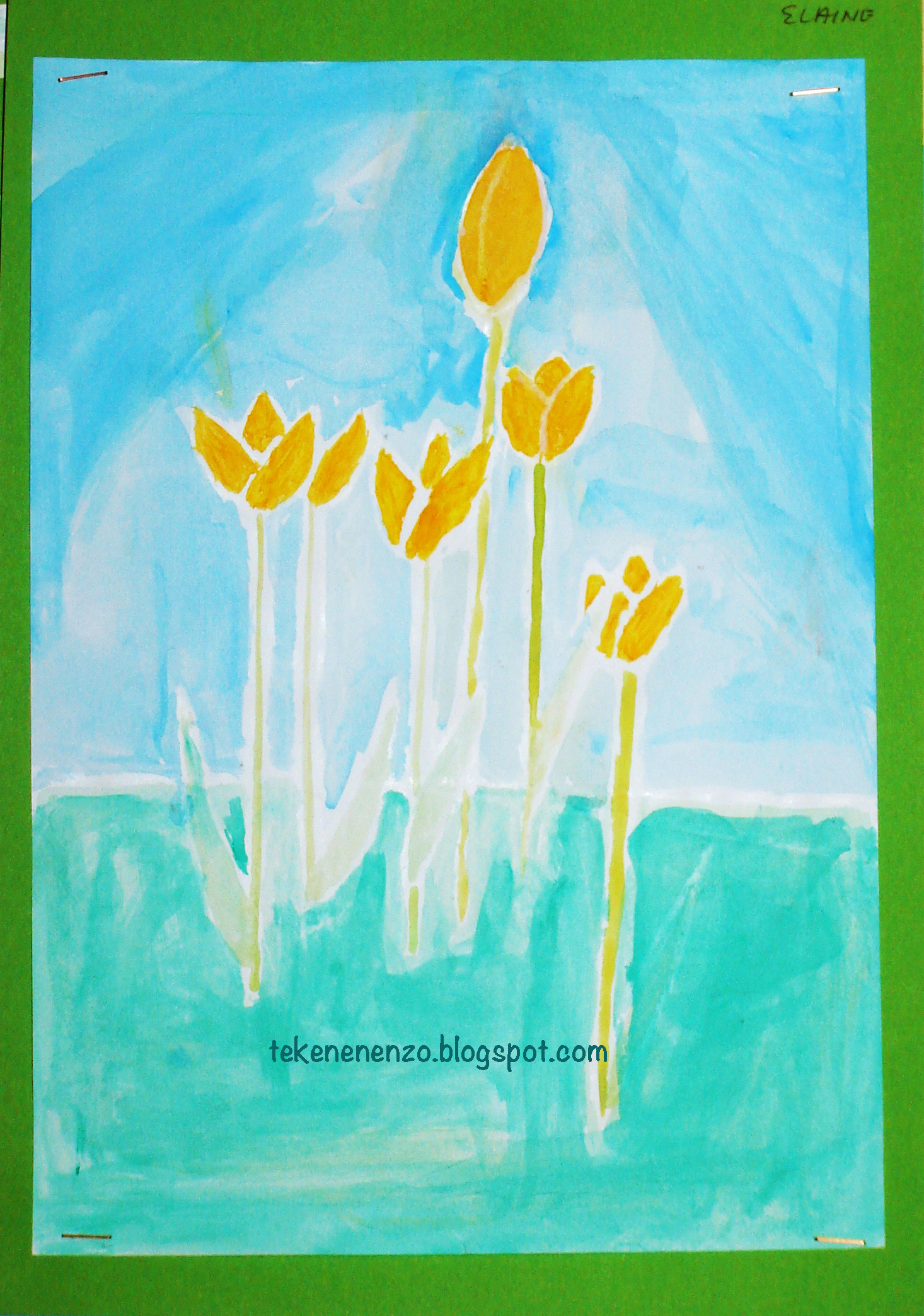
Tulips; spring is coming!

You need:
  1. a bunch of tulips
  2. vases or glasses
  3. drawing paper A4 size
  4. white crayons
  5. water paint
  6. brushes
  7. jar with water
  8. colored paper for background
  9. glue

What does a tulip look like? What can you tell about the stem and the leaves? What do the petals look like? 
Every group gets a vase with some tulips. Students todraw a horizon line about a third from the bottom. 
Draw tulips with a white crayon. Look carefully at the tulips in the vase. The tulips must overlap.
Colour them with water paint, the white lines will remain. Paint the lawn and the air. Stick the artwork on a colored background.


Thursday, July 8, 2021

Fun flowers


What do you need?
  • white or colored drawing sheet
  • scraps of colored paper 
  • scissors
  • glue
  • black markers

What should you do?

  1. Cut several circles from scraps of colored paper and paste them om the sheet. 
  2. Paste smaller circles on the bigger ones. 
  3. Draw petals using black markers in several thicknesses.   

Source: Krokotak.com

Friday, April 29, 2016

Birdies on a branch

Made by a student of grade 1

You need:
  1. liquid water color paint
  2. brushes
  3. crayons
  4. white sheet
  5. feathers
  6. glue
Draw a branch with some birdies on it. Their eyes should be big and white! Color the birds with crayons using bright colors. Paint the branch and background with water color paint. Let dry. Draw feet and paste feathers. 

Thursday, June 5, 2014

Flowers in front of the windows

You need:
  1. coloured construction paper  
  2. tin foil (cut in pieces before lesson starts)
  3. strips of white paper, 2 cm 
  4. black  construction paper 
  5. white drawing sheets 
  6. tempera paint
  7. brushes
  8. scissors
  9. glue 

This lesson is about the flower pots you'll see in spring and summer.
The students get a large piece of oloured construction paper  for the background. Paste the window in the middle of it, with the white strips on it as a inner frame. Cut a pot from black paper. Draw and paint flowers on the white sheet. Cut them after drying with an edge of 1 cm. Paste them in front of the window. Paste the pot on the flowers. Decorate the pot with paint.

Source: Pinterest.

Thursday, May 15, 2014

Funny birds like James Rizzi


I came across this great lesson for our first graders on Deep Space Sparkle. What a fun our students had, making these cute little birds in the style of James Rizzi!

James Rizzi was born in 1950 in Brooklyn. He studied art in Florida (Gainesville), where he started experimenting with printing, painting and sculpting. Rizzi’s work often shows his birthplace New York. His paintings look sometimes childishly naive, with the bright colours and brilliant gaiety. In the art press Rizzi is often described as "Urban Primitive Artist '. Rizzi himself says he is influenced byzelf Picasso, Klee and Dubuffet.

Show some paintings of Rizzi and discuss the characteristics:
  • bright colours
  • no gradations within colours
  • evertything is outlined with a black marker
  • the artwork is full and busy
  • background is full and busy too
You need:
  1. white drawing sheets A4 size cut lengthwise
  2. markers
  3. scissors and glue
  4. blue cardboard A1 size for background
Discuss birds in Rizzi's artwork (google onRizzi + birds) and ask students if the typical Rizzi features are in the bird artworks too. 

The goal for this lesson: 
Use oilpastel to draw a bird just like Rizzi did. Use watercolour paint and paint the bird in one or two colours. Paint the background with several colours.

Artworks made by students of grade 1

Thursday, April 10, 2014

Sheep in the meadow

Made by a student of grade 2

You need:
  1. drawing sheet 
  2. tempera paint
  3. stippling brushes
  4. masking tape
  5. black and white construction paper
  6. glue
Make a fence on the sheet with masking tape. Draw a horizontal line above the fence. Stamp with different colours the meadow. Do not mix the paint. Stamp some spring flowers too.

Stamp the air in the same way with white and blue.
Remove the masking tape. Do this when the paint is still wet.
Cut some clouds for the body of the sheep out of a white sheet. Cut heads and feet out of black paper. Paste the sheep before the fence. Draw eyes and beak with white pencil.

Source: Artsonia. 

Friday, March 14, 2014

Stacked birds

 
Made by students of grade 3/4

You need:
  1. drawing sheet 20 by 40 cm
  2. crayons
  3. liquid watercolour paint
  4. brushes
Inspirated by a picture on Pinterest.
Draw at least three birds sitting on eachothers back. The birds have to get smaller while getting higher. Colour with crayons.
Paint the background with liquid watercolour paint leaving an edge from about 1 cm. 

Saturday, April 27, 2013

Rollercoaster fun


You need:
  1. oil pastels
  2. drawing sheet
  3. watercolour paint
  4. brush
  5. jar with water
After a school trip to an amusement park, these drawings were made. The goal was to draw what you liked most in the park and make sure you're part of the drawing.
Coloured with oil pastel and then painted with a brush and watercolour paint.


Made by styudents of grade 4

Tuesday, January 29, 2013

Suburb for birds

Made by students of grade 4

You need:
  1. coloured cardboard 
  2. wallpaper 
  3. wrapping paper
  4. tempera paint
  5. black marker
  6. brushes
  7. scissors and glue
Students draw a birdhouse with a special entrance on brown wrapping paper. This entrance can be a heart, a star of even a bird. Cut this entrance and outline the hole with a black marker.
Paint the house with cheerful colours.
Paste it on a piece of wallpaper and cut it out with 2 cm around. Paste a strip of black paper on the cardboard, this is the standard for birdhouse. Paste the birdhouse on the standard. Outline the house with black marker.

All birdhouses together will make a colourfull suburb for birds!

Thanks to Maureen Kaal 

Tuesday, October 23, 2012

Four season trees

 
You need:
  1. four white drawing sheets A6 size (postcard)
  2. Q-tips
  3. tempera paint
  4. coloured corrugated cardboard
  5. silver and gold markers
  6. fiberfill
  7. glue
How can a deciduous tree tell you what season it is? What colours do they have in spring, summer and fall? What does a tree look like in winter?

Discuss these questions at the beginning of this lesson. Write on the board the colors in the spring heard (light green, green, white, pink - blossom), which belong to the summer (green, dark green, yellow) and the autumn colours (brown, orange, red, yellow). And in winter there aren't any leaves. left of course.

 
The students will make a tree for every season. The colours of the leaves have to show what season it is. The log is "painted" with a Q-tip, the leaves have to be may only be spotted. Remember that in fall there are a lot of leaves on the ground! Use fiberfill (snow) for the tree in winter.
 
Paste the trees next to each other on a piece of corrugated cardboard. Design it with gold or silver marker and write the seasons above the trees.  

Organisation:
Give each groep of six students an eggtray with several colours of paint. Give each student a Q-tip to paint the trunk. Per groep een eierdoos met de verschillende kleuren verf. Geef de leerlingen elk een wattenstaafje voor de boomstam.For the dots: one Q-tip per colour for common use.
 
Artworks made by students of grade 3
 

Thursday, March 22, 2012

Henhouse

Made by students from kindergarten
You need:
  1. box
  2. brown tempera paint
  3. brush
  4. paper plate
  5. white paper 
  6. red paper
  7. black marker
  8. straw
Paint the outside of the box with brown tempera paint. Fold the plate. Outline your hand and cut it twice out of a white sheet. Paste the hands on both sides of the chicken. Cut a comb and a beak out of red paper and paste them. Paste some feathers for the tail. 
Put the box on its side. Put some straw in the box and put the chicken in it. Stack the boxes of several students for a big hen house!

Tuesday, November 15, 2011

Patterned leaves


You need:
  1. drawing sheet A4 size
  2. pencil
  3. black marker
  4. water colour paint
  5. jar with water
  6. brush
  7. white pencil
  8. coloured sheet
Draw contours of leaves with a pencil on a white sheet. Don't forget some half ones on the edges. Draw veins. Trace the leaves and veins with a black marker. Fill the spaces between the veins with as many different patterns you can.
Paint the space between the leaves with water colour paint. Leave a white edge around the leaves. Let dry. Paste the artwork on a coloured sheet and finish the half leaves with a white pencil on this frame.

Friday, June 24, 2011

Flowers behind fence

Flowers behind fence with fingerprinted flowers, grade 1
You need:
  1. white drawing sheet A4 size
  2. masking tape
  3. scissors
  4. tempera paint
  5. stencil brushes
  6. bubble wrap
  7. sponge strips
Create a fence with pieces of masking tape, about 2 cm from the bottom.
 
 
Cut a piece of bubble wrap that is as large as the sheet of drawing paper. Paint it with a thick brush, half blue and half green. Put the drawing sheet on top and rub with the hand, creating a bubble print. Use sponge strips (cut from an ordinary sponge) to stamp steals and leaves.
Use stencil brushes to stamp petals of use your fingers to print them. Stamp/print some flowers under the fence an between the poles of the fence. Leave the work to dry and gently pull off the masking tape.
Flowers behind fence with stamped flowers, grade 2

Tuesday, April 12, 2011

Printed tulips

 
You need:
  1. cardboard of a box
  2. scissors
  3. block printing ink
  4. flat piece of glass
  5. linoleum roller
  6. white or coloured sheets A4 size
Draw two or three tulips in different sizes on a cardboard box. Cut them. Shake the bottle of blockprint carefully to be sure oil will mix with the rest. Drip some paint on the glass and roll it out with the lino roller. Roll the paint on the tulips and press them on a white or coloured sheet, using a book. Remove the tulips of the sheet and roll them again. Add white to the colour on the glass for a lighter colour. Place the tulips tulips partly overlapping the first, and press again with a book.