Showing posts with label summer. Show all posts

Thursday, August 14, 2025

A day at the beach

What do you need?
  • drawing sheet 
  • white drawing sheets
  • tempera paint
  • brushes
  • scissors
  • markers and/or pencils
  • glue
Before
Talk about a day at the beach: things (to do) on the sand, things (to do) in the water and things (to do) in the air. Talk about people standing in the water: they seem to have half legs!

Cover four tables with newspaper and put three containers with paint on it:
  • yellow and a little brown besides (beach) + two big brushes
  • blue and a little green (seawater) + two big brushes
  • blue and white (air) + two big brushes 
  • white (surf) + two brushes to stamp
Instruction
Show how to paint the beach: a lot of yellow on the brush and a little brown for the beach (do not mix!). Do the same with blue and white for the air, and blue with green for the sea. Make wavy motions with the brush to accentuate the water. Finish with a white stamping brush for the surf.
While four students are painting, the others can start with the drawing part of this lesson

What should you do?
  1. Paint the beach and let dry. 
  2. Draw people and things you see on the beach.
  3. Color with markers or color pencils.
  4. Cut your drawings and paste them on the beach, in the water or the air.
Artworks made by students of grade 5.

Sunday, September 15, 2024

Sunflowers in pieces


This lesson shows we can do more with our artworks than stick them on a colored background. Pretty scary to tear or cut your drawing, but the effect is great! 

What do you need? 

  • white drawing sheet 
  • black construction paper
  • pencil
  • oilpastels
  • liquid water color paint
  • brush
  • scissors and glue

What should you do? 

  1. Draw at least four sunflowers. Be sure three of them are over the edges.
  2. Color with oilpastels. 
  3. Paint the backgrond with liquid water color paint. 

The first drawing is torn in pieces and pasted on black paper with a bit space between them. Before tearing: check which side of the paper is best. One side gives nice white tear lines, the other side does not. 

In these two artworks black strips are pasted on the drawing, creating a window through which you look outside. 

Artworks made by students of grade 6. 

Saturday, June 15, 2024

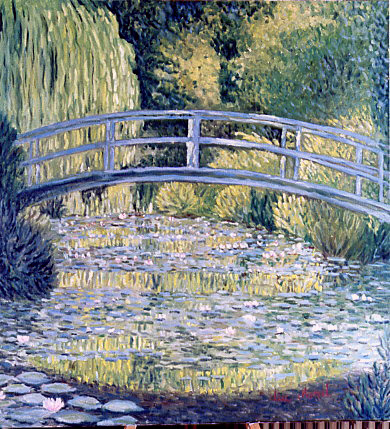
Monet's waterlilies pond

What do you need?

  • drawing paper A3 size
  • tempera paint in green, blue, white, red and yellow
  • two brushes per student
  • two spunges per student
  • paper towels
  • oil pastel crayons 
  • saucers 
About the artist
Claude Monet (1840-1926) is considered one of the most important painters of Impressionism. Typical for Impressionists:

  • they choose subjects from ordinary life 
  • special attention for light and color
  • work in the open air
  • smooth brushstrokes
  • dashes resemble a sketch
  • it's about the impression!
Discuss the term impressionism. Show some paintings by Monet and zoom in on a work with water lilies in Arts & Culture. Do students see the characteristics of impressionism in this artwork?

Monet had a large garden with a pond and a Japanese bridge in Giverny France. He liked to paint in that garden. His works of water lilies are therefore famous and are the basis of this lesson.

What should you do?
Lesson 1
  1. Squeeze blue, green and white paint onto a saucer. 
  2. Dip your sponge into the blue paint. Stamp on the sheet. 
  3. Do the same with green paint and stamp all over the sheet. 
  4. Finally do this with white. You can use the green side of your sponge,  to get a light green color also. 
  5. Let the work dry.
Lesson 2
  1. To paint the water lilies: mix a little bit of red with white paint. Paint ovals spread across the sheet. Not too neat, it's all about impression!
  2. Paint a green border at the bottom of the ovals: the leaf. To make it fresher, you can mix some light green paint. You don't have to clean the green brush first. 
  3. Paint a yellow heart in the flowers. 
  4. Let the work dry. 
  5. Finally draw lines in your lily with a dark red or purple oil pastel: the petals. 
Artworks made by students of grade 1 and 2.

Sunday, May 21, 2023

A field full of daisies

What do you need?
  • white drawing sheet 
  • tempera paint in blue, green, white, yellow and red
  • brushes
  • jars with water
  • colored paper for background
Instruction 
  1. Make your own green colors by mixing blue, white and yellow. Paint the entire sheet with small vertical strokes and let dry.
  2. Paint the daisies; in the front of they are larger  then further away. Use a small brush and a lot of paint, to make sure the grass is really covered with the paint of the flower. Use a different color green for the stalks or take the unmixed color green directly from the bottle. Paint the hearts of the flowers with big yellow blobs.
  3. Paste the artwork on a dark green background.

Artworks made by students of grade 4 and 5. 

Thursday, July 8, 2021

Fun flowers


What do you need?
  • white or colored drawing sheet
  • scraps of colored paper 
  • scissors
  • glue
  • black markers

What should you do?

  1. Cut several circles from scraps of colored paper and paste them om the sheet. 
  2. Paste smaller circles on the bigger ones. 
  3. Draw petals using black markers in several thicknesses.   

Source: Krokotak.com

Wednesday, April 28, 2021

On Monet's bridge


You need: 

  1. drawing sheet A3 size
  2. tempera paint
  3. brushes
  4. white construction paper
  5. scissors
  6. oilpastels
  7. glue
Claude Monet (1840-1926) is considered one of the most important painters of Impressionism. 

 Typical for Impressionists:

  • they choose subjects from ordinary life 
  • special attention for light and color
  • work in the open air
  • smooth brushstrokes
  • dashes resemble a sketch
  • it's about the impression!
Discuss the term impressionism. Show some paintings by Monet and zoom in on a work with water lilies in Arts & Culture. Do students see the characteristics of impressionism in this artwork?

Monet had a large garden with a pond and a Japanese bridge in Giverny France. He liked to paint in that garden. His works of water lilies are therefore famous and are the basis of this lesson.


Lesson 1
Draw a horizon line above the middle of your sheet. Paint the pond and the sky with short brush strokes, like Monet did. Do not mix the paint, but take two colors on your brush.  Make sure the blue color of the pond is not the same color as the sky.
Paint trees on both sides of the sheet in the same way. Paint water lilies in the pond. Be sure that they are larger in the front of the pond than in the back.  

Lesson 2
Have someone take a picture of you that shows you all the way. Print the photo and cut it out. 
Cut three parallel arcs from about 1,5 cm wide from the construction paper.  Then cut four straight pieces of 1,5 cm wide. Paste the photo on the work and paste the bridge over it. 

All artworks are made by students of grade 6

Source: MaryMaking.blogspot.com

Saturday, April 3, 2021

Water lilies on a plate


By a student of grade 1

Claude Monet (1840-1926) is considered one of the most important painters of Impressionism. 

 Typical for Impressionists:

  • they choose subjects from ordinary life 
  • special attention for light and color
  • work in the open air
  • smooth brushstrokes
  • dashes resemble a sketch
  • it's about the impression!

Monet had a large garden with a pond and a Japanese bridge in Giverny France. He liked to paint in that garden. His works of water lilies are therefore famous.

Discuss the term impressionism. Show some paintings by Monet and zoom in on a work with water lilies in Arts & Culture. Do students see the characteristics of impressionism in this artwork?

You need:
  1. paper plates
  2. tempera paint in blue and white 
  3. stencil brush
  4. white drawing sheet 
  5. tissue paper in green an light green 
  6. water and sponge
  7. tissue paper in pink and yellow
  8. mold of a water lily leaf
  9. glue
  10. scissors
Step 1:
Dab the plate with blue and white.  


Step 2:
Wet the white paper with a sponge. Cut squares from the green tissue paper. Place them on the wet paper and let the bleed. Let dry.


Step 3
Remove the tissue paper. Trace the mold of the lilyflower leaf and cut it out.  


Step 4
Fold the tissuepaper for the lily twice diagonally. Cut a flower shape. 


Step 5
Grab the flower shapes in the middle. Crumple them into a flower. Put a drop of glue on the lily leaf and stick the center of the lily on top. Roll a wad of leftover tissue paper and stick it in the center of the flower.

Elements of art: texture, color, space. 

Thursday, April 1, 2021

Paint like an impressionist


This lesson is an exercise for painting an impressionist work.

What do you need?
  • white drawing sheet
  • tempera paint in red, blue and yellow
  • small brushes
  • paper towels
Instruction
View impressionist paintings, for example from Claude Monet or Van Gogh. Zoom into Starry Night from Van Gogh using this link
What do you see?
  • the painting is made out with loose dashes.   
  • the dashes indicate a direction or movement, they are not just placed.
  • you can see the canvas between the dashes. The color of the canvas is therefore part of the painting. 
View a sunset picture. You see the sun reflected in the water and the sun's rays point left, up and right. 

Exercise before you get started: 
  • Practice painting short dashes on a scrap. To do this, always lift the brush from the paper.
  • Practice with two colors on your brush; do not mix!
  • Make narrow/wide dashes by turning/not turning your brush.
  • Clean the brush with a paper towel for a new color, do not use water!
What should you do? 
  1. Fold the sheet in half lengthwise, this is the horizon line.
  2. Draw a semi circle on the horizon line: the sun.
  3. Paint the sun. Apply red and yellow to your brush. Do not mix!
  4. Paint the sun's rays with yellow and very little red. Put something on your brush of both colors and make short strokes by lifting the brush from the paper each time. Leave a bit of white between the strokes.
  5. Make the reflection of the sun in the water. The direction of the brushstrokes must be horizontal now, just like the water.
  6. Paint the sky with blue and white (add two colors to the brush). Use white to make a lighter blue. Follow the direction of the sun's rays. Leave again a bit of white between the strokes.
  7. Paint the sea with blue, white (and maybe green). Do not mix! The direction is horizontal here. Think of the white space between the lines.
Elements of art: line, color, nuance.

Sunday, November 8, 2020

Same insect - different colors


made by student of grade 1

You need:
  1. drawing sheets A5 size
  2. crayons
  3. liquid watercolor paint 
  4. brush
Draw two the same insects and color them with crayons: one with cool colors, the other with warm colors. 
Paint the background with dilluted watercolor paint: warm colors for the 'warm' insect, cool colors for the 'cool' insect. 


Element of art: color.

Thursday, June 16, 2016

Oscar the Octopus


You need:
  1. drawing sheet A2 size
  2. oilpastels
  3. liquid watercolor paint
  4. jar with water
  5. brushes
  6. salt
After a story about Oscar the Octopus and viewing some pictures of squids, students draw a squid in the sea. Big head, big eyes at the bottom of the head, eight tentacles that go over and under each other. These things should be seen in the drawing.

Color with oil pastels and draw patterns. Be sure the tentacles are going over and under each other - this has to be seen in the patterns.  Outline when necessary with a dark color.
Drip some liquid water color on the background after you made it wet. Sprinkle salt  for a great 'watery' effect.
All artworks are made by students of grade 3

Sunday, July 12, 2015

Popsicles

Made by a student of grade 5
You need:
  • water colour paint
  • drawing sheet 25 x 25 cm
  • brush
  • white crayon
  • jarswith water
Dras six popsicles with a white crayon on a white sheet. Paint them with watercolour paint. Paint the background blue, leaving an edge from about 2 cm white.

Sunday, August 31, 2014

Buzzzzzing bees


Made by a student of grade 2.

You need:
  1. bubblewrap
  2. paint roller
  3. drawing sheet 
  4. yellow and brown tempera 
  5. yellow pencil
  6. fine black marker 
Roll a piece of bubble wrap in with yellow paint and print it. Let dry.
Make fingerprints in brown paint and let dry.
Draw lines with yellow pencil on the body of the bee.
Draw wings and legs with black fine liner.

Thursday, June 5, 2014

Flowers in front of the windows

You need:
  1. coloured construction paper  
  2. tin foil (cut in pieces before lesson starts)
  3. strips of white paper, 2 cm 
  4. black  construction paper 
  5. white drawing sheets 
  6. tempera paint
  7. brushes
  8. scissors
  9. glue 

This lesson is about the flower pots you'll see in spring and summer.
The students get a large piece of oloured construction paper  for the background. Paste the window in the middle of it, with the white strips on it as a inner frame. Cut a pot from black paper. Draw and paint flowers on the white sheet. Cut them after drying with an edge of 1 cm. Paste them in front of the window. Paste the pot on the flowers. Decorate the pot with paint.

Source: Pinterest.

Sunday, August 25, 2013

Busy bees


You need:
  1. white crayon
  2. markers
  3. liquid watercolour paint
  4. brush
Fold the sheet of paper in half. Draw on both halves a bee. Colour the body with black and yellow marker. Colour the head black, keeping two white dots for eyes. Draw with black marker six legs and two wings. Use white crayon to draw veins in the wings.
Paint the background and the wings with liquid watercolour while keeping the edges white for about one cm.

Made by students of grade 3/4
Source: Artsonia. 

Saturday, April 27, 2013

Rollercoaster fun


You need:
  1. oil pastels
  2. drawing sheet
  3. watercolour paint
  4. brush
  5. jar with water
After a school trip to an amusement park, these drawings were made. The goal was to draw what you liked most in the park and make sure you're part of the drawing.
Coloured with oil pastel and then painted with a brush and watercolour paint.


Made by styudents of grade 4

Tuesday, October 23, 2012

Four season trees

 
You need:
  1. four white drawing sheets A6 size (postcard)
  2. Q-tips
  3. tempera paint
  4. coloured corrugated cardboard
  5. silver and gold markers
  6. fiberfill
  7. glue
How can a deciduous tree tell you what season it is? What colours do they have in spring, summer and fall? What does a tree look like in winter?

Discuss these questions at the beginning of this lesson. Write on the board the colors in the spring heard (light green, green, white, pink - blossom), which belong to the summer (green, dark green, yellow) and the autumn colours (brown, orange, red, yellow). And in winter there aren't any leaves. left of course.

 
The students will make a tree for every season. The colours of the leaves have to show what season it is. The log is "painted" with a Q-tip, the leaves have to be may only be spotted. Remember that in fall there are a lot of leaves on the ground! Use fiberfill (snow) for the tree in winter.
 
Paste the trees next to each other on a piece of corrugated cardboard. Design it with gold or silver marker and write the seasons above the trees.  

Organisation:
Give each groep of six students an eggtray with several colours of paint. Give each student a Q-tip to paint the trunk. Per groep een eierdoos met de verschillende kleuren verf. Geef de leerlingen elk een wattenstaafje voor de boomstam.For the dots: one Q-tip per colour for common use.
 
Artworks made by students of grade 3
 

Monday, June 25, 2012

Sailing into summer

You need:
  1. white drawing sheet A4 size
  2. pencil
  3. water colour paint
  4. crayons
  5. brushes
  6. jar with water
Draw a horizon line on the half of the sheet using a green crayon. Draw above a green wavy line, these art the bushes. Draw with pencil two sail boats in the water. Colour them with crayons in bright colors. Draw clouds in the sky using a white crayon and colour them white. Draw waves with white crayon in the water. Paint the sky, bushes and water using water colour paint with plenty of water.   The crayons will resist the paint so that clouds and waves become visible again.

Sunday, June 24, 2012

On the beach - collage


You need:
  1. drawing sheet 40 by 35 cm
  2. white drawing sheets
  3. tempera paint
  4. brushes
  5. scissors
  6. markers
  7. glue
  8. pencils
Draw a word web with words about the beach. Think of things (to do) on the sand, things (to do) in the water and things (to do) in the air. Talk about people standing in the water: they seem to have half legs!

Cover four tables with newspaper and put three containers with paint on it:
  • yellow and a little brown besides (beach) + two big brushes
  • blue and a little green (seawater) + two big brushes
  • blue and white (air) + two big brushes 
  • white (surf) + two brushes to stamp
Show how to paint the beach: much yellow on the brush and a little brown for the beach (so do not mix!). Do the same with blue and white for the air, and blue with green for the sea. Make wavy motions with the brush to accentuate the water. Finish with a white stamping brush for the surf.


While about four students are painting, the others can start with the drawing part of this lesson.

Draw people and things you see on the beach. Colour them with markers, and use a skin colour pencil for the bodies. Cut all those little drawings and paste them on the beach, the water or in the air.
Hang all work together for a great group work.

All artworks are made by students of grade 3

Saturday, May 5, 2012

Sunrise like Roy Lichtenstein

A lesson is originally from Phyl's site, There's a dragon in my artroom. Check out her site for more!

You need:
  1. drawing sheet A3 size
  2. tempera in red, blue, yellow, white and black
  3. brushes
  4. jar with water
Roy Lichtenstein (1923 - 1997) was an American popart artist. He is best known for his enormously enlarged cartoons. After his art studies in New York and Columbus Liechtenstein teached art himself. In his spare time he painted abstract paintings and made parodies of American art from the twenties. In1960 he came into contact with Claes Oldenburg and the style elements from advertising and comic strips. He started to use use grids, dots, black outlines and bright colours, the style who made him famous. From 1962 Lichtenstein used the works of Monet, Picasso and Mondrian as the inspiration for his art and he paints sunsets in their style. Most of his work however is based on advertisements and cartoons.

Show artwork of Liechtenstein on the digital board and discuss the characteristics: primary colours sometimes with green,  text balloons, raster dots as we know from newspaper photographs and thick black outlines. Show at the end the work 'Sunrise'. Ask students how they can recognize this work as a Lichtenstein.

The students are instructed to paint a sunrise in the style of Lichtenstein. All Lichtenstein characteristics as discussed so, have to be seen in their painting.

Artworks are made by students of grade 5

Tuesday, May 1, 2012

Lighthouses along the coast


You need:
  1. drawing sheet A6 size (postcard)
  2. watercolour paint
  3. brushes
  4. jar with water
  5. scissors and glue
What are lighthouses? Where can you find them and why there? Why did we need them, and do we still need them?
Show pictures of lighthouses on the digital board and discuss them. What does a lighthouse look like? What colour is often used? Where is the lamp of the lighthouse? Where's the door?

For the background students paint with watercolour paint a simplified landscape of air and soil. The paint should be dilluted with a lot of water to get soft colours. The sheet doesn't need to be painted completely, it is even better to leave the edges white. Put this painting aside to dry.

Then sketch a lighthouse on a second sheet of paper. Paint it with watercolour paint, using less water now to be sure the colours really stand out.
Let the work dry and cut the lighthouse. Paste it on the painted background.
Made by students of grade 3