donderdag 13 april 2023

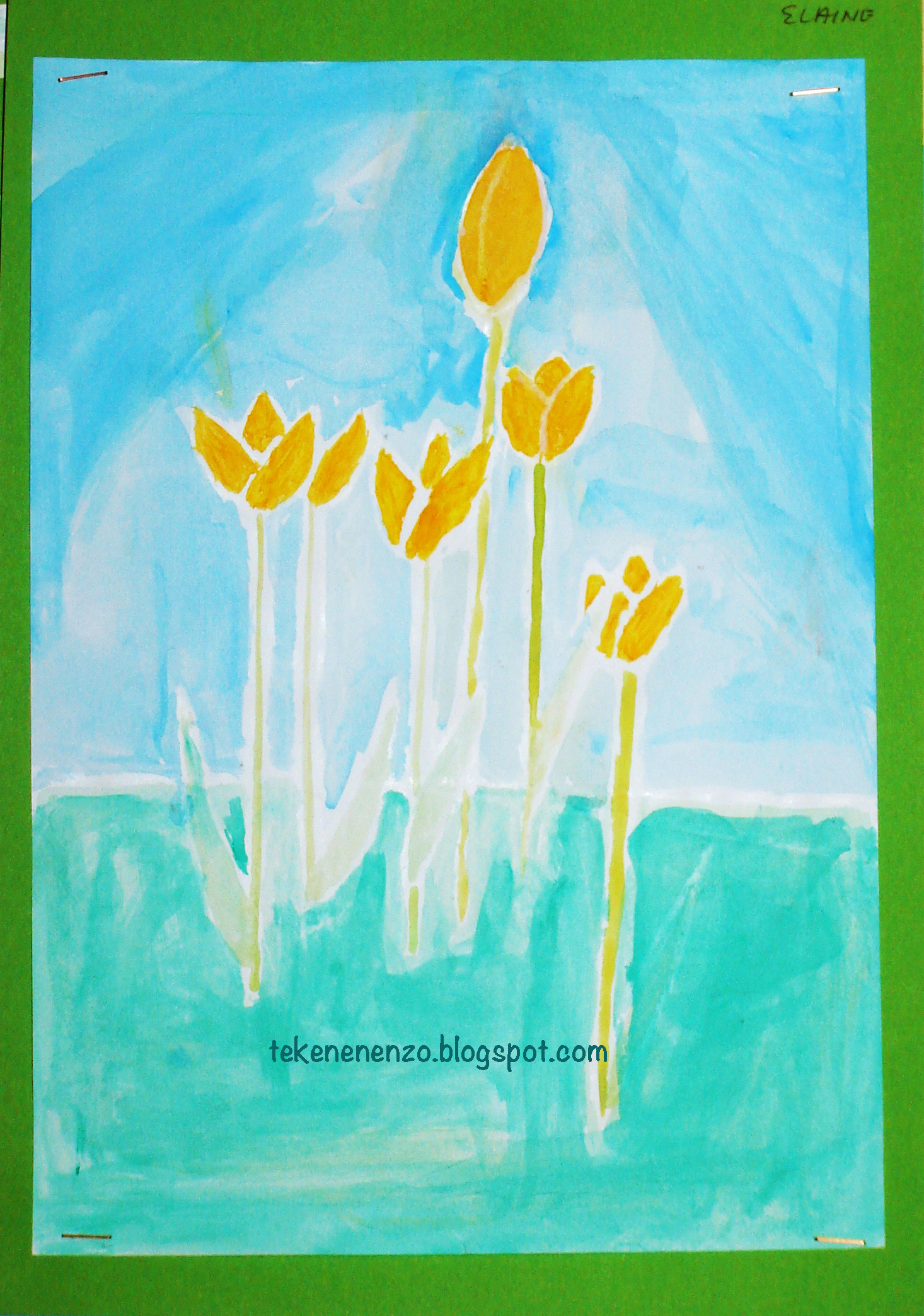
Tulips; spring is coming!

You need:
  1. a bunch of tulips
  2. vases or glasses
  3. drawing paper A4 size
  4. white crayons
  5. water paint
  6. brushes
  7. jar with water
  8. colored paper for background
  9. glue

What does a tulip look like? What can you tell about the stem and the leaves? What do the petals look like? 
Every group gets a vase with some tulips. Students todraw a horizon line about a third from the bottom. 
Draw tulips with a white crayon. Look carefully at the tulips in the vase. The tulips must overlap.
Colour them with water paint, the white lines will remain. Paint the lawn and the air. Stick the artwork on a colored background.


Painting without using your hands


You need: 

  1. big drawing sheets
  2. brushes
  3. tempera paint
  4. liquid water color paint
  5. tape

Painting without using your hands is quite a challenge! You can paint with your feet or mouth. We tried both. 

Painting with your feet
Put tables aside, newspapers on the floor and stick drawing sheets on top. Very important: take off the shoes in the hallway and leave them there 😀

Place a container with three colors tempera paint between two students. A beautiful portrait is too much, so ask them to paint simple lines or shapes. 

Painting with your mouth 
This is less difficult. Cover the tables with newspapers. Place jars with diluted water color paint and brushes. Students may paint what the want. You may also give them a simple goal: paint rectangles in different colors. 


dinsdag 11 april 2023

Japanese cherry blossom on a plate

You need:

  1. paper plates
  2. acrylic paint: brown, green, red, white
  3. brush
  4. crepe paper: pink, white, red
  5. glue 
This lesson about the Japanese cherry blossom is an old one, but now the blossoms are made on a paper plate. Too pretty to use for dinner! 
Branches are painted, leaves too. Not too big, because leaves only grow well when the blossoms are gone. 
Blossom is partly painted and partly made of crumpled crepe paper. 


vrijdag 31 maart 2023

April showers will bring us flowers

You need:
  1. white drawing sheet
  2. water colour paint
  3. ruler
  4. white crayon or oil pastel
  5. paint brush
  6. water
Characteristicly Dutch weather in spring is a weather type with showers, alternated with sunny periods. We call those typical spring showers 'Maartse buien' (March Showers), while English meteorologists speak about 'April showers who bring us flowers'. 

In this lesson children draw spring flowers (tulips, daffodils etc.) during a rain shower.
 
Sketch some spring flowers on a white sheet. Make sure your lines are extremely thin. Use your ruler to draw white crayon lines with one centimeter between them. Make sure your crayon has a sharp point. Paint your drawing with watercolour paint. Use a lot of water to make bright colours. The crayon will resist the water paint, so your shower will be very clear!

donderdag 30 maart 2023

Like Romero Britto

Dutch tulips like Britto 

This was one of my most successful lessons so far; students enjoyed it and the results were amazing. But hello copycats: Britto never painted tulips! So please don't copy this lesson (I saw a lot of them already on art blogs and  Pinterest), but create one yourself. Or at least: mention your source, kidsartists.blogspot.com! 

What do you need?
  1. white drawing sheet 
  2. permanent marker
  3. colour markers
  4. ruler
Paris
About the artist
Brazilian artist Romero Britto was born in 1963 in a deprived neighbourhood in Recife and grew up amongst eight brothers and sisters. He drew and painted on any scrap of newspaper or cardboard he could find and filled them with colourful images of a beautiful world.  
In 1983 Britto travelled to Europe to study the old masters. After this trip he traveled to the USA where popart was flourishing. He opened a gallery in Miami. In 1989 a fabmous vodka brand selected Britto to design an artwork with their logo. From that moment the name Britto was known to a greater public. His artworks are now represented in galleries and museums across five continents.
Meet his work
Look at artworks of Britto on his gallery. Discuss the salient features: 
  • bright colours
  • simple shapes
  • the work is divided into sections that are filled with patterns
  • thick black outlines
Discuss how you see the difference between the drawn picture and the background. Ask about the stylistic characteristics and where to classify this artist (popart).
What should you do? 
  1. Draw a picture of a subject of your choice - no details, just the main lines.
  2. Divide the drawing sheet with pencil and ruler in several sections. 
  3. Trace all lines with a waterproof black marker.
  4. Color the whole sheet with markers like Britto did.
For the background we stamped circles with toilet rolls on a colored sheet and pasted the artwork on it.

Works of art made by students of grade 4 and 6.