zondag 22 maart 2026

What's in your egg?

 
What do you need?
  1. white drawing sheet A5 
  2. charcoal
  3. yellow sheet for background 
  4. hairspray
Surprise!
Imagine you crack your egg on Easter Sunday and it turns out to contain something completely different than egg white and egg yolk ... Draw this fantasy with charcoal on a white sheet. 

Practice first 
Never worked with charcoal? Then practice on a scrap paper first. 
Draw lines, blur them by swiping with your fingers, create shadows, erase the charcoal with a kneaded eraser. Charcoal stains quickly, so clean your  fingers regularly.

What should you do?
  1. Draw two halves of an egg. 
  2. Draw in between what you imagine is in the egg.  
  3. Draw the surrounding. 
  4. Fix your drawing with hairspray. 
  5. Paste the drawing on a yellow sheet. 
Made by students of grade 3.

donderdag 19 maart 2026

Charming chicken

What do you need?
  • blue and yellow construction 
  • oil pastels
  • glue
What should you do?
  1. Draw a chicken on the blue sheet, using the tutorial on How to draw a chicken
  2. Color in bright colours. 
  3. Draw a horizon line and color the ground. 
  4. Draw something on the horizon line, for example a fence or farm. 
  5. Tear the edges of the blue sheet and paste the chicken on a yellow sheet. 

Drawings made by students of grade 6.

woensdag 18 maart 2026

April showers will bring us flowers

What do you need?
  1. white drawing sheet
  2. water color paint
  3. ruler
  4. white crayon 
  5. paint brush
  6. water
Before
Dutch weather in spring is a weather type with showers, alternated with sunny periods. We call those typical spring showers 'Maartse buien' (March Showers), while English meteorologists speak about 'April showers who bring us flowers'. 
In this lesson students have to draw spring flowers (tulips, daffodils etc.) during a rain shower.
 
What should you do?
  1. Sketch some spring flowers on a white sheet. Make sure your lines are extremely thin. 
  2. Draw vertical lines with one centimeter between them using a ruler and a white crayon. Make sure your crayon has a sharp point. 
  3. Paint your drawing with diluted watercolor paint. Use a lot of water to make bright colors. The crayon will resist the water paint, so your shower will be very clear!


zaterdag 7 februari 2026

Athletes in motion


What do you need?

  • colored construction paper
  • white drawing sheet 
  • paperclips
  • scissors
  • cutting mat and cutting knife
  • glue
  • marker
  • printed silhouette of an athlete 
What should you do?
  1. Put three colored sheets together with the printed athlete on top. Fix with paper clips. 
  2. Cut out the athlete and the colored sheets at the same time. Keep moving the paperclips to be sure the four sheets stay together. Use a cutting knife for areas the scissors can't reach.
  3. Make a composition that suggests movement and stick the athletes on the white sheet. 
  4. Use a marker to fill the background with patterns. 
Artworks made by students of grade 6.
Thanks to A faithfull attempt for this great lesson. 

woensdag 4 februari 2026

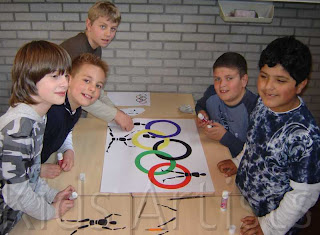
Olympic athletes

Before
Start with the symbol of the Olympics: the colored rings. What do these rings mean? What colors do they have? How are they placed together? 
Ask some students to assume the position of an athlete, for example a skater or skier. Look at their posture: what is the position of their legs, arms and body? 

What do you need?
  • scissors
  • glue
  • white drawing paper A1 size
  • cardboard in Olympic colors
  • copy of athlete
  • compasses


What should you do?
This is a group work for five students. 
Take a big white sheet, cardboard in the colors of the Olympic rings and at least five copies of the athlete.
  1. Each group member cuts an Olympic ring, using compasses and scissors. Be sure all rings have to be the same size.
  2. Cut the ring in one place. Take a good look at which one should go forward and which should go behind it. Make sure the cut ends up under another ring so that you don't see it. 
  3. Cut out the parts of the sports figure. Stick them in different sports positions around, behind, through and in front of the rings.

woensdag 28 januari 2026

Patterned hearts

What do you need?
  • drawing sheet 
  • crayons
  • liquid water color
  • brush

What should you do?

  1. Fold the sheet into 4 rectangles. 
  2. Cut a heart out of a piece cardboard. 
  3. Trace it four times with a pencil. 
  4. Draw patterns in the hearts with crayons: stripes, circles, zigzag lines etc. Draw different patterns around the hearts.
  5. Paint the sheet with liquid watercolor. The crayon will resist the ink.

maandag 26 januari 2026

Connected hearts

What do you need?
  1. white drawing sheet 
  2. small piece of cardboard
  3. scissors
  4. oil pastels
  5. color pencils
  6. watercolor paint
  7. brush
  8. pink of red paper
  9. glue
  10. metallic marker
What should you do?
  1. Draw a heart on a piece of cardboard and cut out. 
  2. Trace the heart several times on the drawing sheet. Make them overlap and draw on the edges as well. 
  3. Draw smaller hearts within the traced ones with half cm space between the two lines. 
  4. Draw and erase pencil lines of the overlapping hearts as if they weave together: below - above - below - above. 
  5. Color the hearts between the double lines with oil pastels. 
  6. Paint the sheet with watercolor paint and let dry. 
  7. Trace hearts on both sides with colored pencils. 
  8. Paste the artwork on a red or pink sheet.
  9. Finish the hearts on the frame with a silver marker.

donderdag 22 januari 2026

Valentine's day (with Jim Dine)

Because of upcoming Valentine's day a lesson about hearts today! Basic colors are red and white (and making pink of these of course).

What do you need? 
  • drawing sheet 20 by 20 cm
  • cardboard 10 by 10 cm
  • pencil and ruler
  • scissors and glue
  • colored pencils
  • markers
  • oil pastel crayons
  • chalk pastel
  • tempera paint + brushes
  • different types of colored paper (ribbed cardboard, tissue paper, crepe paper etc.)
  • watercolor paint + brushes
  • red or pink paper for background
Jim Dine
Jim Dine (Cincinatti, 1935) is a sculptor and popart artist. Hearts, ties and tools are recurrent themes in his art. 
Show his artworks and talk about them. 

Organisation 
Divide the different coloring supplies on several tables. Stimulate students to experiment. How can I make my heart pop up from the paper? Can I combine chalk pastel and oilpastel? What happens when I sprinkle water on tissuepaper? 
Students have to color their hearts and backgrounds by using as many supplies and techniques as possible. They may walk around in the classroom to choose the place with the art supplies of their choice. The only restriction is: are all chairs occupied, choose another supply first. 
What should you do? 
  1. Divide the sheet in four sqaures of 10 by 10 cm. 
  2. Fold the cardboard, draw a half heart against the fold and cut out. 
  3. Trace this heart in the four squares. 
  4. Color the hearts with different coloring supplies. 
  5. Paste the 4 hearts on a red or pink sheet. 
Works of art made by students of grade 5/6.