Showing posts with label cut and glue. Show all posts

Friday, June 5, 2026

The birds of George Braque lesson 2

You need:

  • blue construction paper 
  • colored paper
  • scissors
  • glue

George Braque (1882-1962) was a French painter and sculptor. Together with Picasso he was founder of cubism.
After his cubist time Braque painted simplified figurative paintings of landscapes and still lifes with musical instruments and bottles. Remarkable are the letters and numbers Braque added to his works.
When Braque became ill, he was no longer able to paint. He turned to making color lithographs of simple bird silhouettes. The same birds that can also be seen in one of the ceiling paintings of the Louvre in Paris.

Look at the artwork Les oiseaux of George Braque.  

  • simple shapes (silhouets)
  • white outlines
  • blue background
  • geometrical shapes: stars and moon 

What should you do? 

  1. Draw at least three silhouettes of birds on colored paper. 
  2. Cut them. 
  3. Cut geometrical shapes out of paper scraps. 
  4. Paste everything on a blue sheet.  

Artworks made by students of grade 4.
Elements of art: shape, space.
Techniques: drawing, making a collage, cut and glue 

Friday, May 29, 2026

Sailboat regatta

What do you need?
  1. two sheets drawing paper
  2. sandpaper
  3. tempera paint in blue, green and white
  4. brush
  5. colored paper
  6. brown paper (grocery bag)
  7. glue
  8. large blue sheet
What should you do?

  1. Spray blue, green and white paint on a saucer. 
  2. Lay a sheet of white drawing paper on your table, small size up. Paint it with colored waves. Don't mix the colors on the saucer, but dip the brush in two or three colors. 
  3. Let dry.
  4. Take the second white sheet and lay it on the table with the small side up. Cut a piece of sandpaper as wide as the sheet and 8 cm high. 
  5. Paste it on the bottom of the sheet.
  6. Tear the painted sheet in wavy strips. Be sure all strips have two wavy sides. 
  7. Place the strips overlapping on the white sheet. Start below. Place the second strip partly under the first one, the third under the second etc. Paste down the short sides of the waves only on the left and right side of your sheet.
  8. Cut boats out of a brown paper bag; bigger ones below, smaller ones at the top (perspective). 
  9. Cut masts out of the paper bag and sails out of colored paper. 
  10. Paste the boats between the waves and paste the long sides of the waves at the same time. 
  11. Paste sails and masts on the boats. 
  12. Paste your artwork on a blue sheet. 
Artworks made by students of grade 4.

Wednesday, May 27, 2026

Sunglasses

What do you need?
  • black construction paper 
  • white drawing sheet
  • color pencils or markers
  • scissors
  • glue
  • silver and gold marker

What should you do?

  1. Draw half sunglasses against the fold of a black sheet. 
  2. Cut out. 
  3. Draw a summer scene on the white sheet and color it. 
  4. Put the glasses on it and slide until you see the best part. 
  5. Paste the glasses on the drawing and cut them again. 
  6. Decorate the glasses with gold or silver marker.

Made by students of grade 6. 

Tuesday, May 12, 2026

Still life with fruit

What do you need?
  • corrugated cardboard
  • scissors
  • white drawing sheet
  • tempera paint
  • brush
  • glue
  • colored construction paper
  • fruit
Instruction
Show still lifes of fruit in different styles, for example Caravaggio and Cezanne. How is the fruit arranged? Why at that way? Which parts are light and which parts are dark? What does that mean? Then provide each group of students with a bowl of different fruit types.

What should you do? 
  1. Paint the fruits (no drawing first!) after a good observation. 
  2. Cut a fruit bowl out of cardboard. 
  3. Cut out the fruits with a small white edge. 
  4. Stick them on a colored sheet and let them overlap. 
  5. Stick the cardboard bowl. Some fruits will partly disappear in it. 
Artworks made by students of grade 3.
Elements of art: space, color, value. 

Friday, May 8, 2026

Collage of geometric and organic shapes

A lesson to explain organic and geometric shapes and practice cutting and pasting skills.

What do you need?
  • black construction paper 18 by 18 cm
  • four colored sheets 16 by 16 cm in different colours
  • scissors
  • glue
  • left overs black construction paper
Instruction
A geometric shape is a regular shape. It has a name, like rectangle, circle or square.  An organic shape is a shape from nature. It has no name, it is irregular.

What should you do?

  1. Choose four colored sheets and fold them in four quarters. 
  2. Cut the folding lines to get 16 squares of 4 by 4 cm. 
  3. Put 4 rows of 4 squares neatly against each other on the black sheet. 
  4. Paste the squares. 
  5. Cut a number of organic shapes out of black paper. 
  6. Make a nice composition on the colored background and paste the shapes. 

Artworks made by students of grade 3/4.

Saturday, February 7, 2026

Athletes in motion


What do you need?

  • colored construction paper
  • white drawing sheet 
  • paperclips
  • scissors
  • cutting mat and cutting knife
  • glue
  • marker
  • printed silhouette of an athlete 
What should you do?
  1. Put three colored sheets together with the printed athlete on top. Fix with paper clips. 
  2. Cut out the athlete and the colored sheets at the same time. Keep moving the paperclips to be sure the four sheets stay together. Use a cutting knife for areas the scissors can't reach.
  3. Make a composition that suggests movement and stick the athletes on the white sheet. 
  4. Use a marker to fill the background with patterns. 
Artworks made by students of grade 6.
Thanks to A faithfull attempt for this great lesson. 

Wednesday, February 4, 2026

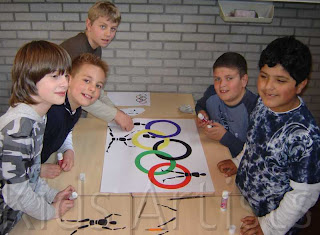
Olympic athletes

Before
Start with the symbol of the Olympics: the colored rings. What do these rings mean? What colors do they have? How are they placed together? 
Ask some students to assume the position of an athlete, for example a skater or skier. Look at their posture: what is the position of their legs, arms and body? 

What do you need?
  • scissors
  • glue
  • white drawing paper A1 size
  • cardboard in Olympic colors
  • copy of athlete
  • compasses


What should you do?
This is a group work for five students. 
Take a big white sheet, cardboard in the colors of the Olympic rings and at least five copies of the athlete.
  1. Each group member cuts an Olympic ring, using compasses and scissors. Be sure all rings have to be the same size.
  2. Cut the ring in one place. Take a good look at which one should go forward and which should go behind it. Make sure the cut ends up under another ring so that you don't see it. 
  3. Cut out the parts of the sports figure. Stick them in different sports positions around, behind, through and in front of the rings.

Wednesday, January 28, 2026

Patterned hearts

What do you need?
  • drawing sheet 
  • crayons
  • liquid water color
  • brush

What should you do?

  1. Fold the sheet into 4 rectangles. 
  2. Cut a heart out of a piece cardboard. 
  3. Trace it four times with a pencil. 
  4. Draw patterns in the hearts with crayons: stripes, circles, zigzag lines etc. Draw different patterns around the hearts.
  5. Paint the sheet with liquid watercolor. The crayon will resist the ink.

Thursday, January 22, 2026

Valentine's day (with Jim Dine)

Because of upcoming Valentine's day a lesson about hearts today! Basic colors are red and white (and making pink of these of course).

What do you need? 
  • drawing sheet 20 by 20 cm
  • cardboard 10 by 10 cm
  • pencil and ruler
  • scissors and glue
  • colored pencils
  • markers
  • oil pastel crayons
  • chalk pastel
  • tempera paint + brushes
  • different types of colored paper (ribbed cardboard, tissue paper, crepe paper etc.)
  • watercolor paint + brushes
  • red or pink paper for background
Jim Dine
Jim Dine (Cincinatti, 1935) is a sculptor and popart artist. Hearts, ties and tools are recurrent themes in his art. 
Show his artworks and talk about them. 

Organisation 
Divide the different coloring supplies on several tables. Stimulate students to experiment. How can I make my heart pop up from the paper? Can I combine chalk pastel and oilpastel? What happens when I sprinkle water on tissuepaper? 
Students have to color their hearts and backgrounds by using as many supplies and techniques as possible. They may walk around in the classroom to choose the place with the art supplies of their choice. The only restriction is: are all chairs occupied, choose another supply first. 
What should you do? 
  1. Divide the sheet in four sqaures of 10 by 10 cm. 
  2. Fold the cardboard, draw a half heart against the fold and cut out. 
  3. Trace this heart in the four squares. 
  4. Color the hearts with different coloring supplies. 
  5. Paste the 4 hearts on a red or pink sheet. 

Works of art made by students of grade 5/6. 

Tuesday, January 20, 2026

Valentine's hearts like Burton Morris

This is one of the most visited (and most copied 😉) posts of my blog: Valentine's hearts like Burton Morris.
In 2011 I received an email of the artist: he had googled himself and came across my lesson! How cool is that! 
During our USA trip in 2009, I visited the Coca-Cola Company in Atlanta  and saw the artwork of Burton Morris for the first time: five paintings of cola bottles in pop-art style surrounded by light blue bubbles. So beautiful! Now I found a way to do this in school. And I think I'm the first blogger with a Morris lesson! 


About the artist
Burton Morris (Pittsburgh, 1964) is an American pop-art artist. He is influenced by artists from the 60's and 70's, like Warhol, Lichtenstein and Haring. Morris's work shows a contemporary twist to traditional pop-art. His characteristic lines with the bright colors give his work a fantastic energy. Morris's work is known of tv-series like Friends and also appears in major advertising campaigns by U.S. companies like AT & T, Pepsi and Heinz.


What do you need?
  • construction paper several colors
  • black cardboard 20 by 20 cm
  • colored sheet 20 by 20 cm
  • scissors
  • glue
  • black marker

Before
Show artwork of Morris and discuss the features: bright colors, black outlines, little detail, movement by little lines, white lines that suggest light and the distinctive black star shape in or around much of his work. 

What should you do?
1. Take two colors cardboard: black for the rug and one for the background. 
2. Cut the edges of the background cardboard in a wavy shape, creating a kind of rug. 
3. Cut a large heart from colored construction paper. 
4. Cut some smaller hearts from several colors of construction paper. 
5. Cut white 'light lines' and paste them on the small hearts, all on the same side.
6. Paste the big heart on the cardboard rug. 
7. Paste the light lines on and around the heart.
8. Cut long triangles from the sides of the rug, the 'flashy stripes'. 
9. Paste the rug on the black cardboard.
 
10. Paste the small hearts around the big heart. 
11. Outline the hearts with a black marker.
12. Cut the black background away, leaving about 2 mm on the edges.
13. Paste the work on a colored sheet and cut it into a square.
Also like Burton Morris is this lesson about pumpkins.
Works of art made by students of grade 5 and 6.  

Monday, January 19, 2026

Snowglobes

What do you need?
  • tempera paint
  • light blue and white drawing paper
  • ribbed cardboard
  • compass
  • black fine marker
  • brushes
  • glitter
  • glue
What should you do?
  1. Use a compass to draw a circle on the blue sheet.
  2. Draw a winter (or Christmas) scene in the circle. 
  3. Paint with undiluted tempera paint. 
  4. Let dry.
  5. Outline the drawing with a fine black marker.
  6. Cut out the circle. 
  7. Draw on the white sheet a circle 1 cm larger than te drawing. 
  8. Paste the drawing on the white circle. 
  9. Cut a stand from ribbed cardboard.
  10. Paste both parts on another sheet.  
  11. Sprinkle glitter in small dots of glue around the drawing.

Made by students of grade 5. 

Sunday, January 18, 2026

Winter trees glimpse

What do you need?
  • three colors cardboard 15 by 20 cm
  • ruler
  • pencil
  • cutting blade
  • cutting mat
  • double sided foamtape
What should you do you?
  1. Draw a rectangle on the three pieces of cardboard 2 cm from the edges. 
  2. Draw wintertrees in the rectangles. The trunk on the bottom, the branches must reach the left, right or upper edge. 
  3. Cut the parts between the branches/trunk and the frame. 
  4. Use double sided foam tape to paste the three windows together. The lightest color in the front, the darkest color on the back.


Works of art are made by students of grade 6. 

Wednesday, January 7, 2026

Winter mittens and cap

What do you need?
  • colored construction paper
  • markers
  • white sheet
  • glue
  • scissors
  • oil pastel
What should you do?
  1. Draw a face and color it with oil pastels. Be sure the eyes are not on top of the head, but in the middle. The space between the two eyes is as wide as an eye.
  2. Cut mittens and a hat from colored paper (or trace templates first and cut them). 
  3. Draw patterns on hat and mittens with a marker. The patterns on both mittens should be similar, as well as the patterns on the hat.
  4. Paste hat and mittens on the drawing. Make sure the thumbs point to each other!
Drawings made by students of grade 2. 

Tuesday, December 30, 2025

Happy new year


What do you need? 
  • white drawing sheet 
  • blue liquid water color paint 
  • brush
  • crayons
  • black construction paper
  • leftovers of yellow and orange paper
  • yellow chalk pastel

What should you do? 
  1. Draw fireworks with crayons on a white sheet. 
  2. Paint the whole sheet with blue liquid water color paint. 
  3. Let dry.
  4. Cut a skyline out of half a sheet of black paper. 
  5. Paste the skyline on the blue sheet. 
  6. Cut windows from yellow or orange paper.
  7. Draw a yellow chalk line on the roofs and smudge it.   
Works of art made by students of grade 3, 4 and 5.

Sunday, December 14, 2025

Christmas carolers

What do you need? 
  • green construction paper 
  • scissors and glue
  • leftovers paper or Christmas scrapbook paper
  • fine markers in black and silver
Before:
Christmas carolers are individuals or groups who sing traditional holiday songs, known as carols, during the Christmas season, often traveling from house to house or performing in public spaces.
What should you do? 
  1. Cut the parts of the singers: head with the nose up and open mouth, thin arms and legs, dress or suit and black shoes or boots.
  2. Cut a music book and fold it. 
  3. Draw the title on it: Christmas Carols.
  4. Draw some staves with musical notes.
  5. Glue the parts on a large green sheet. Paste three-dimensional if possible: paste the dress with folds; arms come out of sleeves holding the 3D pasted music book. 
  6. Draw nostrils with a black marker and shoe laces with the silver one.
  7. Make a large group work of these Christmas carolers!

Works of art made by students of grade 6.