Sunday, August 26, 2012

Turning around with Keith Haring


You need:
  1. drawing sheets 20 by 20 cm
  2. pencil
  3. markers
  4. coloured contruction paper 
  5. glue
I found this lesson on Pinterest, it's originally from DaVinci's Wings.
Show artwork of Keith Haring (1958-1990) and talk about the characteristics of his work:
 
people are drawn as in cartoons
fewdetails
thick black lines and contours
bright colors
• dashes indicate movement
Students draw figures in Keith Haring style. The sheet must be filled completely and also rotatably: the figures are not all the same way, but are crisscrossing the drawing. Furthermore, also figures on the edge of the sheet, to make the drawing more exciting (what happens beyond the edges?)
All figures have to be coloured with marker; choose just one colour. Outline with a black fineliner and then add motion dashes.
Paste work on construction paper that is the same color as the marker colour.

See also my other lessons about Keith Haring:
 
Artworks made by students of grade 4

Monday, June 25, 2012

Sailing into summer

You need:
  1. white drawing sheet A4 size
  2. pencil
  3. water colour paint
  4. crayons
  5. brushes
  6. jar with water
Draw a horizon line on the half of the sheet using a green crayon. Draw above a green wavy line, these art the bushes. Draw with pencil two sail boats in the water. Colour them with crayons in bright colors. Draw clouds in the sky using a white crayon and colour them white. Draw waves with white crayon in the water. Paint the sky, bushes and water using water colour paint with plenty of water.   The crayons will resist the paint so that clouds and waves become visible again.

Sunday, June 24, 2012

On the beach - collage


You need:
  1. drawing sheet 40 by 35 cm
  2. white drawing sheets
  3. tempera paint
  4. brushes
  5. scissors
  6. markers
  7. glue
  8. pencils
Draw a word web with words about the beach. Think of things (to do) on the sand, things (to do) in the water and things (to do) in the air. Talk about people standing in the water: they seem to have half legs!

Cover four tables with newspaper and put three containers with paint on it:
  • yellow and a little brown besides (beach) + two big brushes
  • blue and a little green (seawater) + two big brushes
  • blue and white (air) + two big brushes 
  • white (surf) + two brushes to stamp
Show how to paint the beach: much yellow on the brush and a little brown for the beach (so do not mix!). Do the same with blue and white for the air, and blue with green for the sea. Make wavy motions with the brush to accentuate the water. Finish with a white stamping brush for the surf.


While about four students are painting, the others can start with the drawing part of this lesson.

Draw people and things you see on the beach. Colour them with markers, and use a skin colour pencil for the bodies. Cut all those little drawings and paste them on the beach, the water or in the air.
Hang all work together for a great group work.

All artworks are made by students of grade 3

Monday, June 11, 2012

Comics like Roy Lichtenstein

 
Artworks are made by students of grade 3

A lesson based on a lesson from Phyl's site, There's a dragon in my artroom, but instead of painting I decided to choose for collage. Check out Phyl's site for the paintings!

You need:
  1. coloured paper A4 size
  2. white drawing sheet A4 size
  3. newspaper
  4. ruler and pencil
  5. glue
  6. crayons
  7. glitter
  8. colour markers
Roy Lichtenstein (1923 - 1997) was an American popart artist. He is best known for his enormously enlarged cartoons. After his art studies in New York and Columbus Liechtenstein teached art himself. In his spare time he painted abstract paintings and made parodies of American art from the twenties. In1960 he came into contact with Claes Oldenburg and the style elements from advertising and comic strips. He started to use use grids, dots, black outlines and bright colours, the style who made him famous. From 1962 Lichtenstein used the works of Monet, Picasso and Mondrian as the inspiration for his art and he paints sunsets in their style. Most of his work however is based on advertisements and cartoons.

Show artwork of Liechtenstein on the digital board and discuss the characteristics: primary colours sometimes with green, text balloons, raster dots as we know from newspaper photographs and thick black outlines. Show comic balloons from Lichtenstein and discuss them.

In this lesson students create a comic balloon like Lichtenstein did. Choose for a basic form, a star or cloud. See my 'how to draw a star step by step' below.
Cut this or cloud out of coloured paper. Cut another cloud or star from a newspaper. Draw an action word on the white sheet and colour with markers. Cut this word. Create composition and paste the parts of the artwork. Draw action stripes with black crayon or use glitter.

How to draw a star:
1. Draw a circle.
2. Draw lines from the edges to the circle, using pencil and ruler. See the black lines in the picture.


3. Draw lines from the same places but make them diagonal. See the red lines in the picture.
4. Cut the parts between the triangles, the blue pieces in the picture.

Tuesday, May 29, 2012

Sculptures like Niki de Saint Phalle


You need:
  1. newspapers torn in strips
  2. wallpaper paste
  3. paper towels
  4. tempera paint
  5. varnish
  6. brushes
  7. yarn
  8. white wall paint
Niki de Saint Phalle (1930 - 2002) was a French painter and sculptor. She made reliefs in plaster and other materials. Especially her feminine 'Nana's' are famous. These large sculptures of women painted in bright expressive colours are world famous and to be seen in several major cities in the world.

Show some pictures of Niki de Saint Phalle on the digital board. Discuss the salient features: bright colours, black outlinesof the colour patches - including circles, often (thick) women without a clear face. Then show images of the sculptures in Paris (google Nikki de Saint Phalle and Paris). What is different about these images? Those sculptures are the famous female characters, but they do have the typical De Saint Phalle characteristics.
 
Students are going to create an artwork of paper mache with at least one hole in it and two protruding parts. Provide at least eight layers of newspaper finish with paper towels.
Paint the sculpture after drying with white wall paint and let dry. Paint then in the style of Saint Phalle using bright colors.
Wait until the paint is dry and paint the black lines using a small brush or use a black marker. Paint with varnish. Pull a thread through the hole and hang the work.
 
Artworks made by students of grade 5

Thursday, May 10, 2012

Art cows

 
Artworks made by students of grade 2

You need:
  1. 3 sheets of drawing paper 15 by 15 cm
  2. colour pencils
  3. coloured paper for background
  4. glue
Students have to draw three different cows: a realistic one, a cubistic one and a cow in just blue colours like the Dutch pottery from Delft.
Paste those three works on a strip of coloured construction paper.

Saturday, May 5, 2012

Sunrise like Roy Lichtenstein

A lesson is originally from Phyl's site, There's a dragon in my artroom. Check out her site for more!

You need:
  1. drawing sheet A3 size
  2. tempera in red, blue, yellow, white and black
  3. brushes
  4. jar with water
Roy Lichtenstein (1923 - 1997) was an American popart artist. He is best known for his enormously enlarged cartoons. After his art studies in New York and Columbus Liechtenstein teached art himself. In his spare time he painted abstract paintings and made parodies of American art from the twenties. In1960 he came into contact with Claes Oldenburg and the style elements from advertising and comic strips. He started to use use grids, dots, black outlines and bright colours, the style who made him famous. From 1962 Lichtenstein used the works of Monet, Picasso and Mondrian as the inspiration for his art and he paints sunsets in their style. Most of his work however is based on advertisements and cartoons.

Show artwork of Liechtenstein on the digital board and discuss the characteristics: primary colours sometimes with green,  text balloons, raster dots as we know from newspaper photographs and thick black outlines. Show at the end the work 'Sunrise'. Ask students how they can recognize this work as a Lichtenstein.

The students are instructed to paint a sunrise in the style of Lichtenstein. All Lichtenstein characteristics as discussed so, have to be seen in their painting.

Artworks are made by students of grade 5

Tuesday, May 1, 2012

Lighthouses along the coast


You need:
  1. drawing sheet A6 size (postcard)
  2. watercolour paint
  3. brushes
  4. jar with water
  5. scissors and glue
What are lighthouses? Where can you find them and why there? Why did we need them, and do we still need them?
Show pictures of lighthouses on the digital board and discuss them. What does a lighthouse look like? What colour is often used? Where is the lamp of the lighthouse? Where's the door?

For the background students paint with watercolour paint a simplified landscape of air and soil. The paint should be dilluted with a lot of water to get soft colours. The sheet doesn't need to be painted completely, it is even better to leave the edges white. Put this painting aside to dry.

Then sketch a lighthouse on a second sheet of paper. Paint it with watercolour paint, using less water now to be sure the colours really stand out.
Let the work dry and cut the lighthouse. Paste it on the painted background.
Made by students of grade 3

Thursday, March 22, 2012

Henhouse

Made by students from kindergarten
You need:
  1. box
  2. brown tempera paint
  3. brush
  4. paper plate
  5. white paper 
  6. red paper
  7. black marker
  8. straw
Paint the outside of the box with brown tempera paint. Fold the plate. Outline your hand and cut it twice out of a white sheet. Paste the hands on both sides of the chicken. Cut a comb and a beak out of red paper and paste them. Paste some feathers for the tail. 
Put the box on its side. Put some straw in the box and put the chicken in it. Stack the boxes of several students for a big hen house!

Saturday, February 18, 2012

Patchwork landscape

By a student of grade 3.
You need:
  1. white drawing sheets
  2. tempera paint
  3. brushes
This is an easy lesson in perspective for younger students. Talk about perspective and show the picture of the disappearing railway.
Do a step by step guide on the blackboard to make this drawing:


1. Put the sheet in the width for you.
2. Draw a wavy line on 2/3 of the bottom.
3. Place a dot in the middle on the top of the sheet.
4. Draw lines with a ruler from the bottom and sides of the sheet to the dot.
5. Divide the strips in squares.
6. Draw houses and trees on the horizon line.


After this the students can finish their artwork independently. Paint the squares all different and use different patterns. Stpale or paste the artwork on a coloured background.

Saturday, January 28, 2012

Pastel planets


You need:
  1. black construction paper A4 size
  2. chalk pastel
  3. hairspray
During our school project about Space, students of grade 5 made these fantasy solar system. Spheres were drawn with attention towards an imaginary light source creating light and dark values. Overlap was required to suggest depth. To suggest the endlessness of the universe, parts of planets had to be drawn at the edge of the sheet.
 
Draw circles by tracing round subjects or use compasses. Colour with chalk pastel. Note the technique of the chalk: colour, smear and blend until you're satisfied. Fix the artwork with hairspray.
 

Saturday, January 14, 2012

A journey through space


You need:
  1. white drawing paper A5 size
  2. crayons
  3. black paint
  4. brush
  5. toothpick
  6. coloured construction paper
As part of a school project about the Dutch astronaut André Kuipers and his space journey, students scratched these drawings.
Colour the entire drawing sheet with crayons. Choose the colours you want, but don't use black or white. Then Paint the entire sheet black and let dry. Scratch a space scene with a toothpick. Paste the artwork on a coloured background.

All artworks are made by students of grade 3

Friday, January 6, 2012

Stamped polar bears

 
Made by students of grade 1

You need:
  1. blue construction paper
  2. pencil
  3. tempera paint white and black
  4. marshmellows
  5. brush
  6. glitter
  7. glue
Show how to draw a polar bear out of simple shapes: circle, half of a circle (ears) and a part of a triangle for the body. Talk about the grey shadow under the head. How do you make gray? Tell students they have to stamp with marshmellows or brushes. Do not paint!

Students draw the head of a polar bear on blue paper. Use white to stamp head and body. Use grey to stamp the shadow. Paint eyes and nose with a small brush. Decorate the artwork with glitter.

Monday, December 12, 2011

Winter scenes

You need:
  1. styrofoam
  2. pencil
  3. block printing ink
  4. paint roller
  5. flat piece of plexiglass
  6. coloured paper
Explain the principle of printing. Why is it that people started to print texts and pictures?

Draw a winter scene with a pencil on the styrofoam. Squeeze out “toothpaste” amount of ink on plexiglass. Roll ink out. The ink is ready when lines appear. Ink should look wet.
Put the styrofoam on a newspaper. Roll one colour ink onto the foam, working quickly to cover all areas. Lay a sheet on top of foam and press with a flat hand. Take away the sheet and your print is ready. Let dry and cut it with about 1 cm around. Paste one or more prints on a white sheet. Decorate the frame with fingerprints.
Made by students of grade 2

Tuesday, December 6, 2011

House in cubist style

By a student of grade 4

You need:
  1. drawing paper A4 size
  2. colour markers
  3. pencil
  4. ruler
Draw a house simplified house with windows and a door. Add one or two trees. Divide the sheet in with three horizontal and three vertical lines. Colour the surfaces with four different coloured markers.

Saturday, November 26, 2011

Amsterdam by night

You need:
  1. white drawing sheet A4 size
  2. liquid water colour
  3. brush
  4. jar with water
  5. indian ink
  6. straw
  7. black and yellow construction paper
  8. scissors
  9. glue
Paint the white sheet blue or orange with liquid water colour; add water to get a brighter blue / orange above. Let dry. Drip some indian ink and blow it upwards with a straw. Cut a row of canal houses out of black paper and paste it on the coloured sheet. Cut and paste windows and a moon out of yellow paper.
Paste the artwork on a black sheet.
Artworks made by students of grade 4

Monday, November 21, 2011

Northern lights


You need:
  1. black construction paper A4 size
  2. chalk pastel
  3. white wallpaper with texture
  4. scissors
  5. glue
  6. fine black marker
I found this lesson via Flickr on Pinterest, but don't know to whom I have to give credit...
Show some northern light movies on Youtube. What can you tell about the colours? What movements do you see?

Draw a horizon line a little below the middle of a black sheet. Use different colours chalk pastels to colour the sea. Do not use too much chalk, so that it can be smudged.
Cut a strip of mountains out of black paper. Paste it on the horizon line. Use white chalk pastel to make snow on the mountains. Draw the northern light above the mountains. Smudge colours.
Draw a polar bear on an ice floe on the back of a piece of white wallpaper. Cut out. Draw details with a fine black marker. Paste the polar bear on the sea.
Finally paste the artwork on a bright coloured sheet.

By students of grade 5

Tuesday, November 15, 2011

Patterned leaves


You need:
  1. drawing sheet A4 size
  2. pencil
  3. black marker
  4. water colour paint
  5. jar with water
  6. brush
  7. white pencil
  8. coloured sheet
Draw contours of leaves with a pencil on a white sheet. Don't forget some half ones on the edges. Draw veins. Trace the leaves and veins with a black marker. Fill the spaces between the veins with as many different patterns you can.
Paint the space between the leaves with water colour paint. Leave a white edge around the leaves. Let dry. Paste the artwork on a coloured sheet and finish the half leaves with a white pencil on this frame.

Sunday, October 23, 2011

Outlined autumn leaves

Made by a student of grade 5
You need:

  1. white drawing sheet A4 size
  2. liquid water colour yellow and red
  3. brush
  4. colour markers
  5. glue
  6. scissors
Paint a wet white sheet with red and yellow liquid water colour. Leave to dry.  Outline some autumn leaves on this sheet, cut them and paste them on a new sheet.
Choose three markers in wamr (autumn) colours and outline the leaves until the sheet is full. Draw the veins with a fine marker.

Saturday, October 22, 2011

Blob creatures


You need:
  1. white drawing sheet A4 size
  2. tempera paint
  3. scissors
  4. glue
  5. black marker
  6. black paper for background
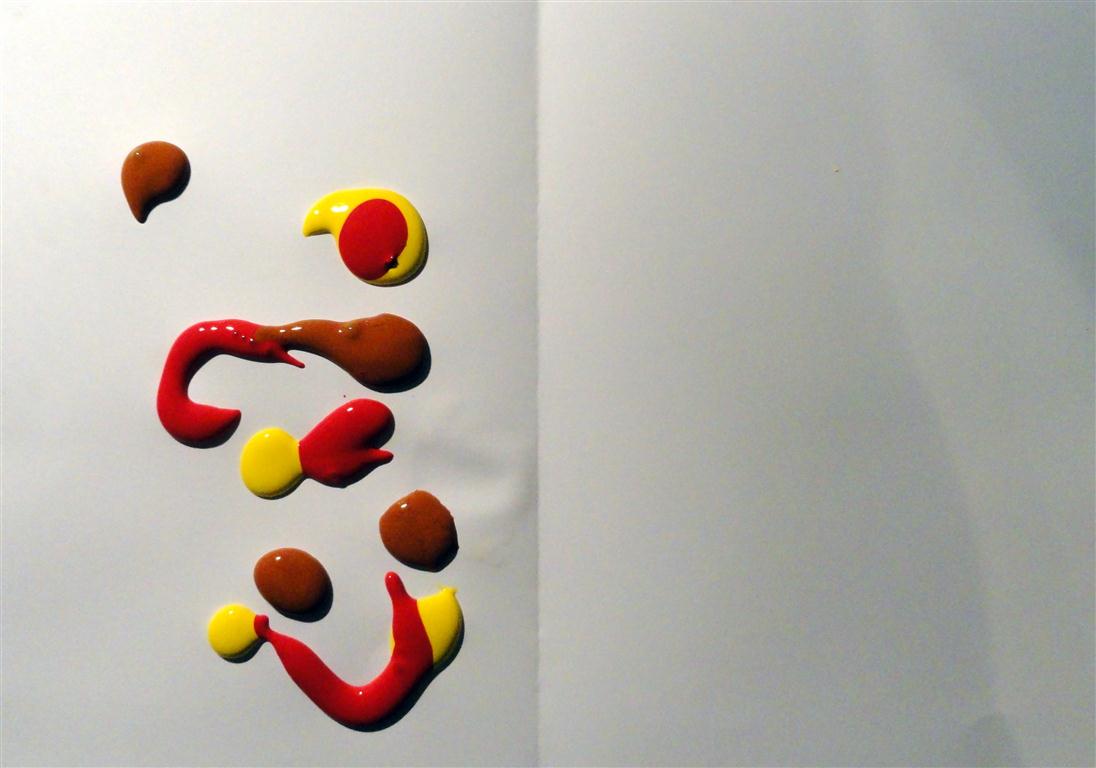
Start by folding the white sheet of paper in half and open it up again. Then drop blobs of tempera paint in three different colours somewhere around the middle of your paper. Don't put the paint to close to the edges. Fold the sheet and press by firmly moving hands around. This movement will move the paint around more than just folding.


Open the paper and dry flat.
Look carefully at this creature. Outline the creature with a black marker. Look for typical shapes, like arms, eyes, ears etc. and trace them with a marker. The drawing should be totally symmetrical.

Cut the creature, leaving half cm white around the black lines. Paste it on a coloured background.
Made by students of grade 4