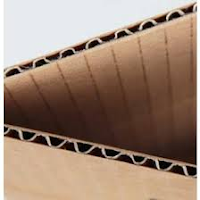
- corrugated cardboard or a cardboard box
- scissors
- roller
- blockprint or tempera paint*
- colored or white sheets
dinsdag 12 maart 2024
Pretty tulip prints
You need:
Cut a simple tulip from cardboard. Roll them in different colors and print several times on a sheet. Experiment with colors on top of each other and wet in wet. Print the tulips in several heights and let them overlap for a spatial effect. Let dry and stick the art work on a colored sheet.
* blockprint dries more slowly and therefore works better than tempera paint.
With cardboard boxes you can make beautiful prints. These tulips are cut from a cardboard box.
roll in with block print
Elements of art: space, color, texture.
donderdag 7 maart 2024
Mix and match with Mondrian
by students of grade 3
You need:
- white sheets 21 by 21 cm
- black sheet 23 bij cm
- paper strips 3 by 6 cm in yellow, red and blue
- black squares 3 by 3 cm
- glue
I did this lesson in grade 5, students worked in pairs. The figures are cut before class. Per art work you need 4 black squares and 16 colored rectangles
The assignment is:
- make a composition of 4 squares, each consisting of 4 colored rectangles and a black square in the middle. Make sure there are no 2 of the same colors next to each other
- paste the composition on the white sheet, keeping a small white edge visible around each shape.
- finally paste the art work on a black surface
Students from higher groups can measure and cut the figures themselves.
Difficult assigment and not everyone succeeded!
Elements of art: shape, color, line.
Labels:
collage,
cut and glue,
famous artists,
grade 3,
grade 4,
grade 5,
grade 6
dinsdag 5 maart 2024
Grey, like Theo van Doesburg
Theo van Doesburg (1883-1931) was a Dutch painter, architect and writer. He was charmed by the abstract art of Kandinsky and the cubism of Picasso. In 1917 he founded the magazine De Stijl (The Style), in which he and other artists could publish their innovative ideas. Well-known artists who also belong to De Stijl are Piet Mondriaan, Bart van der Leck and Gerrit Rietveld.
Characteristics of the Stijl artists:
- use of primary colors and non-colors
- horizontal and vertical lines
- use of geometric shapes
- strive for balance and harmony in the artwork
Van Doesburg, Composition 12 - abstraction of a landscape, 1918
In this lesson we discuss an artwork from 1917 that hangs in the Guggenheim New York. No primary colors, but only the non-colors black and white and everything in between.The goal for this lesson is not to copy the work, but to practice the technique of working with charcoal.
Van Doesburg, Composition in grey, 1919
Look at the painting and discuss what stands out:
- no color, only non-colors
- geometric shapes with some rounded corners
- suggestion of depth: some surfaces appear to rise through the use of light and
- dark next to eachother
- only horizontal and vertical lines
How to make your own Van der Leck?
First practice drawing with charcoal on a scrap. Press hard, soft, wipe. Get to know the material this way.
Divide the sheet into rectangles using a pencil and ruler. Color with charcoal. Make sure that lines between the rectangles are clearly visible. Create color nuances by pressing harder or softer, rubbing and wiping.
Stick the work on a black sheet.
Elements of art: color, nuance, line, shape.
Artworks made by students of grade 5.
dinsdag 30 mei 2023
A lesson in color theory
You need:
- 4 cards of drawing paper, 10 by 7 cm
- pencil
- ruler
- felt tip pens of color pencils
- black construction paper
What are primary colors and why are they called so? What are secondary colors, how do you make them and why are they called so? What are the neutral colors? Discuss the word color nuance.
What should you do?
- Draw a frame on the cards at 2 mm from the edge using a thin black marker.
- Draw a pattern of your choice on each card.
- Color the cards according to the terms discussed.
- Outline the patterns with a thin black marker.
- Stick the cards on a black background.
- Add the learned words.
Elements of art: color, line, nuance.
Labels:
colour pencils,
colour theory,
grade 1,
grade 2,
grade 3,
markers
donderdag 25 mei 2023
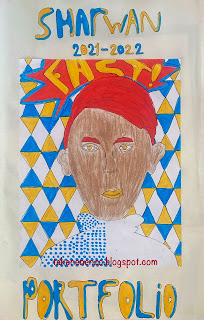
Selfportrait like Roy Lichtenstein
At our school it's customary to keep artwork at school until the of the school year. Students make a portfolio in june to take their work home.
On front of it is a drawing in the style of one of the art movements we studied that year. In 2021-2022 it was pop art.
These are the grade 6 portfolio folders with a self portrait in the style of Roy Lichtenstein.

You need:
For the folder: paper A1 size, folded in half
For the drawing:
- white drawing paper A4 size
- markers
- skin color pencils
- fine marker in black
Show artwork of Lichtenstein and discuss the important features: use of primary colors (sometimes with green), grid dots, black outlines, speech bubbles and slogans (onomatopoeia).
contents portfolio folder grade 6
How?
- Draw a self portrait on the small sheet.
- Add a text in a speech bubble that suits you.
- Color your face using skin color pencils. Use markers for the rest of your drawing.
- Fill one part of your drawing with dots.
- Fill the background with a pattern.
- Outline everything with a black marker.
- Past e your work on the large sheet.
- Draw in large letters: portfolio + you name + the school year.
all artworks are made by students of grade 6
zondag 21 mei 2023
A field full of daisies
Made by a student of grade 5
You need:- white drawing sheet A3 size
- tempera paint in blue, green, white, yellow and red
- egg boxes or saucers
- brushes
- jars with water
- newspapers
- paper towels
- coloured paper for background
Daisies (bellis perennis) are, until it freezes, found in lawns. View pictures of daisies and discuss what they look like.
Students start to paint the grass. They have to make their own green colors by mixing blue, white and yellow. Paint the entire sheet with small vertical strokes and let dry.
Then the daisies can be painted. In the front of the field daisies are larger then further away. Use a small brush and a lot of paint, to make sure the green grass is really covered with the white paint of the flower.
Use a different color green for the stalks or take the unmixed color green directly from the bottle. Paint the hearts of the flowers with big yellow blobs.
Paste the artwork on a matching background.
dinsdag 2 mei 2023
Prisoners in World War II
You need:
- white drawing sheet A4 size
- ribbed cardboard
- pencil
- watercolour paint
- brushes
- jar with water
- black wool
- glue
"We had to draw one or more people in a concentration camp. Our drawings should show the fear and powerlessness of the prisoners. Most of all did well and the artworks were really beautiful. When the drawing was finished, we had to paint it with watercolour paint, using sad colours. We used black wool to make barbed wire and pasted it in front of the drawing. Finally we pasted the artworks on ribbed cardboard. It was an intense task, and it made us really think about that terrible time."
Artworks are made by students of grade 6
Abonneren op:
Reacties (Atom)


.jpg)
.jpg)