Wednesday, April 28, 2021

On Monet's bridge


You need: 

  1. drawing sheet A3 size
  2. tempera paint
  3. brushes
  4. white construction paper
  5. scissors
  6. oilpastels
  7. glue
Claude Monet (1840-1926) is considered one of the most important painters of Impressionism. 

 Typical for Impressionists:

  • they choose subjects from ordinary life 
  • special attention for light and color
  • work in the open air
  • smooth brushstrokes
  • dashes resemble a sketch
  • it's about the impression!
Discuss the term impressionism. Show some paintings by Monet and zoom in on a work with water lilies in Arts & Culture. Do students see the characteristics of impressionism in this artwork?

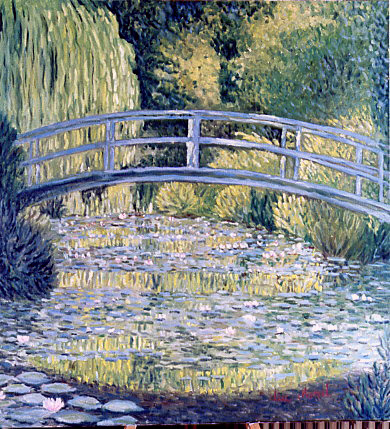
Monet had a large garden with a pond and a Japanese bridge in Giverny France. He liked to paint in that garden. His works of water lilies are therefore famous and are the basis of this lesson.

Lesson 1
Draw a horizon line above the middle of your sheet. Paint the pond and the sky with short brush strokes, like Monet did. Do not mix the paint, but take two colors on your brush.  Make sure the blue color of the pond is not the same color as the sky.
Paint trees on both sides of the sheet in the same way. Paint water lilies in the pond. Be sure that they are larger in the front of the pond than in the back.  

Lesson 2
Have someone take a picture of you that shows you all the way. Print the photo and cut it out. 
Cut three parallel arcs from about 1,5 cm wide from the construction paper.  Then cut four straight pieces of 1,5 cm wide. Paste the photo on the work and paste the bridge over it. 

All artworks are made by students of grade 6

Source: MaryMaking.blogspot.com

Sunday, April 25, 2021

Van Gogh's bedroom

        by a student of grade 6 

You need:
  1. for prints: black and white sheets 18 by 14 cm 
  2. for background: black and white construction paper 31 by 19 cm
  3. linoleum 16 by 12 cm
  4. carbon paper
  5. lino knife
  6. flat piece of glass 
  7. block printing ink
  8. lino roller
  9. lino press
  10. glue

The painting The bedroom is from 1888. View this painting and discuss it  using elements of art. What do you see? What stands out? What do you see on the wall? What can you say about the perspective? What materials did Van Gogh use? What do you think about the colors? Do you like the painting or not, and why is that?  

Print the image below on 12 by 16 cm for each student. 

Transfer the white lines from the image to the linoleum using carbon paper and a pen. Cut out the white lines and parts. 


Cut out your name in mirror writing at the bottom left. 
Make four prints: two with white paint on black paper and two with black paint on white paper. Let dry. 
Stick the white sheets on black paper and the black sheets on white paper. Use 1 cm of the sheets to stick them together.

all artworks of grade 6

Elements of art: color, space, line. 

Sunday, April 4, 2021

Starry Night like Vincent van Gogh


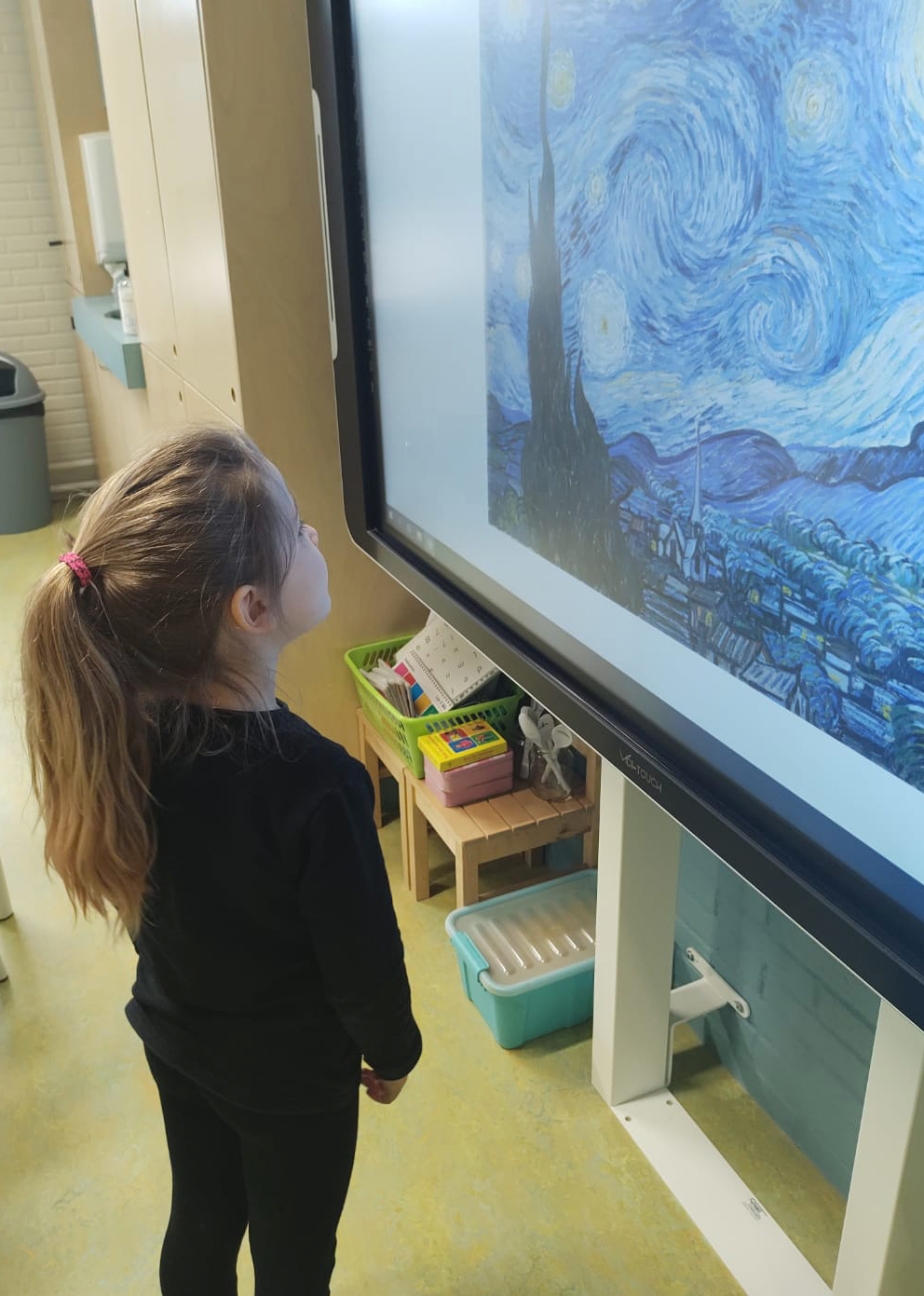
Show during both lessons hVan Gogh's painting Starry Night.  


Tell about Vincent van Gogh. Show Starry Night. Zoom in on the painting with Arts & Culture

The artwork students are going to make, will take two lessons.  

You need for the 1st lesson:
  1. black construction paper 
  2. aluminium foil
  3. piece of cardboard or a clay plate
  4. painter's tape
  5. tempera paint in blue and white 
  6. cotton swab
  7. brushes
  8. plate

Lesson 1
Wrap the cardboard/clay plate with aluminum foil and tape it on the back side. 

Step 1: For each pair of students there is a palette with blue and white paint. Students paint spiral shapes ons the aluminum foil with a brush and / or cotton swabs.


Stap 2: Make a print by placing a black sheet on top of your painting and pressing it.  

Stap 3: Remove the black sheet and let dry. 


 You need for the 2nd lesson:

  1. oilpastels in black, grey and purple
  2. tempera paint in yellow and white 
  3. black construction papier
  4. brushes
  5. scissors
  6. glue
  7. plate
Step 4: Draw and color the mountains with oilpastels. Draw the wavy movements in the air. The lines must run parallel to each other and also go in the same direction during a movement.
Show students that you can fade the colors by smearing the oil pastel. This way you can also make the colors darker or lighter.


Step 5: Determine where the large dark cypress should be and cut it out of black paper. (In grade 3 we gave students a shape to trace for the cypress.)


Step 6: Cut houses and glue them on tje painting. Draw lighted windows with oilpastels.  


Step 7: Paint moon and stars with tempera. 

Artworks are made by students of grade 3.

Elements of art: color, line, nuance, texture.


Saturday, April 3, 2021

Water lilies on a plate


By a student of grade 1

Claude Monet (1840-1926) is considered one of the most important painters of Impressionism. 

 Typical for Impressionists:

  • they choose subjects from ordinary life 
  • special attention for light and color
  • work in the open air
  • smooth brushstrokes
  • dashes resemble a sketch
  • it's about the impression!

Monet had a large garden with a pond and a Japanese bridge in Giverny France. He liked to paint in that garden. His works of water lilies are therefore famous.

Discuss the term impressionism. Show some paintings by Monet and zoom in on a work with water lilies in Arts & Culture. Do students see the characteristics of impressionism in this artwork?

You need:
  1. paper plates
  2. tempera paint in blue and white 
  3. stencil brush
  4. white drawing sheet 
  5. tissue paper in green an light green 
  6. water and sponge
  7. tissue paper in pink and yellow
  8. mold of a water lily leaf
  9. glue
  10. scissors
Step 1:
Dab the plate with blue and white.  


Step 2:
Wet the white paper with a sponge. Cut squares from the green tissue paper. Place them on the wet paper and let the bleed. Let dry.


Step 3
Remove the tissue paper. Trace the mold of the lilyflower leaf and cut it out.  


Step 4
Fold the tissuepaper for the lily twice diagonally. Cut a flower shape. 


Step 5
Grab the flower shapes in the middle. Crumple them into a flower. Put a drop of glue on the lily leaf and stick the center of the lily on top. Roll a wad of leftover tissue paper and stick it in the center of the flower.

Elements of art: texture, color, space. 

Thursday, April 1, 2021

Paint like an impressionist


This lesson is an exercise for painting an impressionist work.

What do you need?
  • white drawing sheet
  • tempera paint in red, blue and yellow
  • small brushes
  • paper towels
Instruction
View impressionist paintings, for example from Claude Monet or Van Gogh. Zoom into Starry Night from Van Gogh using this link
What do you see?
  • the painting is made out with loose dashes.   
  • the dashes indicate a direction or movement, they are not just placed.
  • you can see the canvas between the dashes. The color of the canvas is therefore part of the painting. 
View a sunset picture. You see the sun reflected in the water and the sun's rays point left, up and right. 

Exercise before you get started: 
  • Practice painting short dashes on a scrap. To do this, always lift the brush from the paper.
  • Practice with two colors on your brush; do not mix!
  • Make narrow/wide dashes by turning/not turning your brush.
  • Clean the brush with a paper towel for a new color, do not use water!
What should you do? 
  1. Fold the sheet in half lengthwise, this is the horizon line.
  2. Draw a semi circle on the horizon line: the sun.
  3. Paint the sun. Apply red and yellow to your brush. Do not mix!
  4. Paint the sun's rays with yellow and very little red. Put something on your brush of both colors and make short strokes by lifting the brush from the paper each time. Leave a bit of white between the strokes.
  5. Make the reflection of the sun in the water. The direction of the brushstrokes must be horizontal now, just like the water.
  6. Paint the sky with blue and white (add two colors to the brush). Use white to make a lighter blue. Follow the direction of the sun's rays. Leave again a bit of white between the strokes.
  7. Paint the sea with blue, white (and maybe green). Do not mix! The direction is horizontal here. Think of the white space between the lines.
Elements of art: line, color, nuance.

Monday, December 28, 2020

Stained glas animals

 
made by students of grade 5

You need:

  1. black construction paper 
  2. wax paper in several colors
  3. white pencil
  4. ruler
  5. cutting mat 
  6. cutting knife
  7. glue

A stained glass window is a window in which several pieces of (mostly colored) glass are stuck in frames of lead. Stained-glass windows were made in times when it wasn't possible yet to make a window in one piece. We see those stained glass windows in old houses, but especially in churches. The light from outside enters in multiple colors into the church. 

View stained glass windows and tel about their origin and the effect of the colored light.  

Use a white pencil to draw an animal on the black sheet. Draw at least three lines from the animal to all edges of the sheet. Divide the animal into some surfaces. 
Make all lines 1 cm wide. Hatch the surfaces between the 1 cm lines with the white pencil.
Cut the white area's. When ready, use the black sheet as a template to draw the pieces of wax paper. Cut them out with an extra 0,5 cm and stick them behind the window. Make sure that there are no two same colors next to each other. 

Elements of art: line, shape, color. 
Technique: cutting.
Connecting with: history. 

Sunday, November 8, 2020

Same insect - different colors


made by student of grade 1

You need:
  1. drawing sheets A5 size
  2. crayons
  3. liquid watercolor paint 
  4. brush
Draw two the same insects and color them with crayons: one with cool colors, the other with warm colors. 
Paint the background with dilluted watercolor paint: warm colors for the 'warm' insect, cool colors for the 'cool' insect. 


Element of art: color.

Friday, October 30, 2020

Mondrian, a bit different

 You need:

  1. white drawing sheet
  2. markers
  3. ruler
  4. pencil
Draw a Mondrian, but change one of the elements of art. For example: 
  • do not draw squares and rectangles, choose another geometric shape
  • do not color with primary colors, choose maximum four other colors
Draw your alternative Mondrian and color it with markers. Outline with black marker. 

Elements of art: color, shape, line. 

Thursday, October 29, 2020

Mondrian in chalk pastels

 You need:

  1. black construction paper 
  2. pencil
  3. ruler
  4. chalk pastels 
  5. Elmer's glue 
  6. fixing spray
Look at and discuss about the artwork of Piet Mondrian.

Draw squares and rectangles on the black sheet using a pencil and a ruler. trace the lines with Elmer's glue. The glue will become transparent when it has dried. 
Color the squares and rectangles with soft pastels in white, black, red, yellow and blue. Instead of black pastels, you can leave some areas open. Be sure you don't get two areas of the same color next to each other. 
Fix the work with hairspray or fixative spray. 

Elements of art: color, shape, line. 

Still life with fruit

door leerlingen van groep 5

You need:
  1. corrugated cardboard
  2. scissors
  3. white drawing sheet
  4. tempera paint
  5. brush
  6. glue
  7. colored construction paper
Vies and discuss still lifes of fruit in different styles (for example Caravaggio and Cezanne). How is the fruit arranged? Why at that way? Which parts are light and which parts are dark? What does that mean? 


Provide each group of students with a bowl of different fruit types. Students paint the fruits (no drawing first!) after a good observation. 
Cut a fruit bowl out of the cardboard. Cut out the fruits with a small white edge. Stick the fruits on a colored sheet, be sure to let them overlap each other. Stick the cardboard bowl. Some fruits will partly disappear in it. 

Elements of art: space, color, value. 

Thursday, October 22, 2020

Keith Haring figures on tissue paper

What do you need?
  1. colored tissuepaper
  2. white drawing sheet
  3. jar with water
  4. brush
  5. scissors
  6. templates of Haring figures
  7. pencil
  8. black marker
What should you do?
  1. Choose 2 or 3 colors of tissuepaper. Fold them in 16 squares. Cut out. 
  2. Take a drawing sheet and wet it with a brush and water. 
  3. Lay the pieces of tissue paper on the wet sheet and see how they bleed. Fill the whole sheet and be sure to use enough water. 
  4. Let dry and remove the tissue paper. 
  5. Cut two or more Haring templates and outline them with a pencil. 
  6. Trace the lines with black marker and trace them again to make nice bold lines. 
Works of art made by students of grade 3. 

Sunday, October 18, 2020

In 'The Factory' of Andy Warhol

made by students of grade 1

You need: 

  1. colored paper 12 by 12 cm
  2. black construction paper 50 cm by 15 cm 
  3. tempera paint
  4. brushes
  5. apples
  6. glue
  7. black marker 

Tell about Andy Warhol's Factory. 

First lesson: "We are going to work today in the factory of Andy Warhol. Choose four colored sheets. Make apple prints in complementary colors: on a blue sheet you print an orange apple, on a red sheet you print a green apple etc."

Let dry and paste the colored sheets on black construction paper.

Second lesson: make a second print in a complementary color: on the orange apple you print a blue one etc. Let dry. Outline the apples with a black marker and add seeds and stem. 


Thursday, September 17, 2020

Blue dotted paper mache plates and bowls


You need:

  1. plate or bowl
  2. newspaper strips
  3. wallpaper paste
  4. white wall paint
  5. tempera paint
  6. cotton swabs
Cover newspaper strips with wallpaper paste on bowl or plate. Be sure to have 6 layers. Let dry.
Remove the paper mache carefully. Paint it white with wall paint. Let dry.
Use cotton swabs to print patters of blue dots. 


Saturday, September 12, 2020

The birds of George Braque lesson 2

artworks are made by students of grade 4

This is lesson 2 about George Braque. First lesson: click here.  

You need:

  1. blue construction paper 
  2. colored paper
  3. scissors
  4. glue

George Braque (1882-1962) was a French painter and sculptor. Together with Picasso he was founder of cubism.
After is cubist time, Braque painted simplified figurative paintings of landscapes and still lifes with musical instruments and bottles. Remarkable are the letters and nummers Braque added to his works.
When Braque became ill, he was no longer able to paint. He turned to making color litographs of simple bird silhouettes. The same birds you that can also be seen in one of the ceiling paintings of the Louvre in Paris.

Look at the artwork Les oiseaux of George Braque.  

  • simple shapes (silhouet)
  • white outlines
  • blue background
  • geometrical shapes: stars and moon 

What do you have to do: 
Draw at least three silhouettes of birds on colored paper. Cut them. Cut geometrical shapes out of paper scraps. Paste everything on the blue sheet.  


Elements of art: shape, space.
Techniques: drawing, making a collage, cut and glue 

Monday, September 7, 2020

The flowers of Andy Warhol


You need:
  1. black construction paper A4 size
  2. brushes
  3. tempera paint
  4. scraps of colored paper
  5. scissors 
  6. glue
Andy Warhol - popart
Andy Warhol (1928-1897) was an American painter, photographer and filmaker. He started his working life as an advertising artist and became an artist in the early 1960's. He
 introduced everyday consumer products into his artwork, such as Campbell's soup cans and Coco Cola bottles. 

Warhol is one of the leading artists of Pop art. 
Using printing techniques he created large series of works of Marilyn Monroe or political themes such as the electric chair. Warhol used photographs of others to edit.
The Flowers series clearly show how Warhol applied the silkscreen printing technique. We see the flowers of the rare Hibiscus fragilus.  
The Flowers series are also seen as Warhol's answer toe Van Gogh's famous paintings of sunflowers and Claude Monet's artworks of water lilies. 

Stamp green and yellow tempera on a black sheet of paper leaving about one inch of the edges black. Let dry. 
Cut at least four flowers with five petals from scraps of colored paper. Do not draw in first, but cut by hand. Stick the flowers on the black sheet. No overlap. 

Elements of art: shape, color

Wednesday, August 26, 2020

Birthday calendar in one color


You need:

  1. drawing sheet
  2. tempera paint
  3. ruler
  4. pencil
  5. black marker
Draw with pencil a geometric shape in the middle of the sheet. Draw horizontal and vertical lines to divide the background in rectangles. Do the same within the shape. Paint the rectangles in values of one color, using a basic color + black and white. Start with the lightest color. 
Outline all shapes with black marker.

Elements of art: color, line, shape, value