Showing posts with label painting. Show all posts

Saturday, November 1, 2025

Autumn birches

What do you need?

  • drawing sheets *
  • painters tape in several widths
  • liquid watercolor paint in red, green and yellow 
  • brushes
  • tempera paint  
  • stencil brush
  • old shopping card/customer card
  • saucers and jars
* Choose thick drawing paper, to avoid ripping when you remove the tape . 

Before:
Look at birch trees. What do you see?   
 

  • straight white trunks
  • horizontal peeling bark
  • autumn color leaves: orange, yellow, brown, red
What to do?
Step 1
Place the sheet on the table with the narrow site down. Stick strips of tape from top to bottom. Wide for the trunks, narrower for the branches. Note: branches grow up! 
Step 2
Paint the background in strips with diluted liquid watercolor. Let dry. Peel off the tape carefully. 
Step 3
Put some black tempera paint on a saucer. Dip a customer card in it. Pull this in several places from left to right (or right to left!) to halfway up the trunk to make the black streaks.
Step 4
Spray some warm colors tempera + green on a saucer.  Stamp leaves at the top of the trees using the stencil brush. Do not mix colors, but use several colors at the brush at the same time. 

Step 5
Hang up! 

Works of art made by students of grade 1. 

Thursday, October 9, 2025

Autumn leaves in cubist style


What do you need?
  • white drawing sheet 
  • pencil
  • ruler
  • tempera paint
  • brushes
  • gold marker

Before
Ask students to take autumn leaves. Watch them together, paying particular attention to the shape: heart-shaped, oval, round, oblong, etc. The composition of the leaves may vary: a leave can be single or composed of several leaflets (pinnate or palmately).

What should you do?

  1. Draw several leaves, they may not overlap. Draw half leaves against the edges. Draw only the outer form of the leaves, no veins. 
  2. If the sheet is largely filled, draw diagonal lines with pencil and ruler: two from left to right and two from top to bottom. Make sure these lines pass through the leaves. 
  3. Choose four warm colors tempera: two for the leaves and two for the background. Paint the leave parts within a shape in one color and the background in a different one. Paint the leaves in the next square in a third color and the background with color four. 
  4. Trace contour lines of the leaves and the diagonal lines with a gold marker.

Works of art made by students of grade 6.

Wednesday, October 8, 2025

Whirling leaves

What do you need?
  • white drawing sheet 
  • watercolor paint
  • brushes
  • jar with water
  • small and thick black marker
  • construction paper for background
  • glue

Before
Ask students to take flat dried leaves. 

What should you do?

  1. Chooses a leave and outline it several times with a pencil. Let them whirl down from the tree. Make sure some leaves go over the edge; these will later be finished on the background.
  2. Paint the leaves with watercolor paint. Use water to dillute the paint less or more. Choose warm fall colors and try to make transitions in the colors by using wet in wet technique.
  3. Paint the background blue. Use again the wet in wet technique, and/or choose for wet on dry. You don't have to paint exactly against the leaves, they will be outlined later.
  4. Leave the work to dry and paste it on a colored background. 
  5. Outline the leaves with a thick black marker. Use the fine marker for the veins. Don't stop with outlining and drawing veins when you reach the background, but go on with it there.

Works of arde made by students of grade 6.

Sunday, September 21, 2025

It's warm blanket time!

What do you need?
  • colored paper for background
  • brown paper 
  • leftovers of colored and white paper 
  • square white paper
  • watercolor paint + brushes
  • crayons
  • black marker
  • scissors and glue
Before
Divide this lesson over more moments. Consider in advance whether you will give students a template of the bear's head or whether they' ll have to draw it themselves. 
What should you do?

Folding and painting: 
  1. For the blanket: fold the white sheet into16 squares. 
  2. Paint each square in a different color. 
  3. Let dry. 
  4. Draw stripes with a crayon on the folds of the squares like on a patchwork blanket. 

Cutting:
  1. Draw a bear's head on brown paper and cut out (or trace the template and cut out)
  2. Legs: cut four ovals out of brown paper. 
  3. Snout: cut a circle out of colored paper. 
  4. Ears: cut two half circles out of colored paper. 
  5. Eyes: cut two small circles out of white paper. 
Pasting and drawing:
  1. Stick the hind legs on the colored sheet. 
  2. Stick the blanket so that legs come out from underneath.
  3. Stick the head halfway on the blanket and the front legs underneath.  
  4. Stick snout, eyes and ears on the head.
  5. Draw nose, whiskers and pupils with a black marker. 
Works of art made by students of grade 1.  


Friday, August 15, 2025

The vase of Kandinsky

What do you need?

  • colored cardboard A3 size
  • sponges
  • paint rollers 
  • strips of ribbed cardboard
  • bubble wrap
  • tempera paint
  • brushes
  • scissors  
  • glue
Read here about Kandinsky's concentred circles. 

Organisation
Divide this lesson in two moments. For lesson 1 (step 1-4) create four table groups where students can print. Divide students among these four groups. When someone is ready, he can go to the next group. In this way students rotate between the groups. In lesson 2 (step 5) the individual parts are combined into a work of art and students sit in their own place in the classroom.  

Group A: printing with sponges. One sponge per color. Some paper plates with tempera paint and a paint roller on each plate. 

Group B: printing with cardboard. Lay out cardboard strips  about the width of a ruler. Spray s few colors of tempera paint on paper plates. Students smear the head side of the cardboard with a brush, see picture. 

Group C: printing with bubble wrap. Lay out A4 drawing sheets and pieces of bubble wrat. Students roll in the bubble wrap with a paint roller and print it on a sheet. 

Group D: painting concentric circles. Place thick drawing paper, tempera paint and paper plates here. 

What should you do? 
Step 1: Place the cardboard upright in front of you. Stamp approximately 1/3 of the bottom full with a sponge and paint. Don't rub, stamp!  

Step 2: Stamp with the cardboard strips horizontal and vertical stripes above the sponge strips. 


Step 3: Use a paint roller to roll a piece of bubble plastic with tempera paint and print it on a white sheet. Let dry. 


Step 4: Fold a white A4 sheet into 6 squares. Paint 6 different concentric circles in each square like Kandinsky did. Each circle has 3 colors. Let dry.  


Step 5: Cut the circles. Draw a symmetric vase on the back side of the bubble plastic print and cut out. Paste vase and flowers on the colored cardboard. 

Works of art made by students of grade 3.
 

Thursday, August 14, 2025

A day at the beach

What do you need?
  • drawing sheet 
  • white drawing sheets
  • tempera paint
  • brushes
  • scissors
  • markers and/or pencils
  • glue
Before
Talk about a day at the beach: things (to do) on the sand, things (to do) in the water and things (to do) in the air. Talk about people standing in the water: they seem to have half legs!

Cover four tables with newspaper and put three containers with paint on it:
  • yellow and a little brown besides (beach) + two big brushes
  • blue and a little green (seawater) + two big brushes
  • blue and white (air) + two big brushes 
  • white (surf) + two brushes to stamp
Instruction
Show how to paint the beach: a lot of yellow on the brush and a little brown for the beach (do not mix!). Do the same with blue and white for the air, and blue with green for the sea. Make wavy motions with the brush to accentuate the water. Finish with a white stamping brush for the surf.
While four students are painting, the others can start with the drawing part of this lesson

What should you do?
  1. Paint the beach and let dry. 
  2. Draw people and things you see on the beach.
  3. Color with markers or color pencils.
  4. Cut your drawings and paste them on the beach, in the water or the air.
Artworks made by students of grade 5.

Saturday, June 15, 2024

Monet's waterlilies pond

What do you need?

  • drawing paper A3 size
  • tempera paint in green, blue, white, red and yellow
  • two brushes per student
  • two spunges per student
  • paper towels
  • oil pastel crayons 
  • saucers 
About the artist
Claude Monet (1840-1926) is considered one of the most important painters of Impressionism. Typical for Impressionists:

  • they choose subjects from ordinary life 
  • special attention for light and color
  • work in the open air
  • smooth brushstrokes
  • dashes resemble a sketch
  • it's about the impression!
Discuss the term impressionism. Show some paintings by Monet and zoom in on a work with water lilies in Arts & Culture. Do students see the characteristics of impressionism in this artwork?

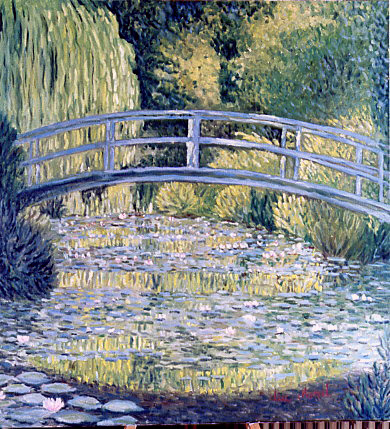
Monet had a large garden with a pond and a Japanese bridge in Giverny France. He liked to paint in that garden. His works of water lilies are therefore famous and are the basis of this lesson.

What should you do?
Lesson 1
  1. Squeeze blue, green and white paint onto a saucer. 
  2. Dip your sponge into the blue paint. Stamp on the sheet. 
  3. Do the same with green paint and stamp all over the sheet. 
  4. Finally do this with white. You can use the green side of your sponge,  to get a light green color also. 
  5. Let the work dry.
Lesson 2
  1. To paint the water lilies: mix a little bit of red with white paint. Paint ovals spread across the sheet. Not too neat, it's all about impression!
  2. Paint a green border at the bottom of the ovals: the leaf. To make it fresher, you can mix some light green paint. You don't have to clean the green brush first. 
  3. Paint a yellow heart in the flowers. 
  4. Let the work dry. 
  5. Finally draw lines in your lily with a dark red or purple oil pastel: the petals. 
Artworks made by students of grade 1 and 2.

Tuesday, April 2, 2024

Mexican amate

What do you need?
  • brown paper bag
  • tempera paint in fluorescent colors and white
  • brushes
  • jar with water
  • black marker
  • colored paper for background
  • glue 
 
Instruction

Amate is a way of making paper, done for centuries by Mexican Indians. Amate paper is made by cooking the inner bark of various trees. At the beginning of the 20th century the Nahua Indians of Mexico started making amate paintings as a form of folk art, especially in order to exchange and sell them to tourists.
Show pictures of Mexican amate paintings. Discuss the features: birds, flowers, bright colors, black outlines and a frame with a pattern in bright colors.

What should you do?
  1. Tear the edges off the paper: use thumb and fingers of both hands and tear slowly. 
  2. Draw some birds and flowers with pencil and draw a patterned frame.
  3. Paint the drawing with fluorescent tempera. 
  4. Let dry and outline everything with a black marker. 
  5. Paste the artwork on colored construction paper.
Artworks made by students of grade 5-8. 

Sunday, May 21, 2023

A field full of daisies

What do you need?
  • white drawing sheet 
  • tempera paint in blue, green, white, yellow and red
  • brushes
  • jars with water
  • colored paper for background
Instruction 
  1. Make your own green colors by mixing blue, white and yellow. Paint the entire sheet with small vertical strokes and let dry.
  2. Paint the daisies; in the front of they are larger  then further away. Use a small brush and a lot of paint, to make sure the grass is really covered with the paint of the flower. Use a different color green for the stalks or take the unmixed color green directly from the bottle. Paint the hearts of the flowers with big yellow blobs.
  3. Paste the artwork on a dark green background.

Artworks made by students of grade 4 and 5. 

Thursday, April 13, 2023

Tulips; spring is coming!

You need:
  1. a bunch of tulips
  2. vases or glasses
  3. drawing paper A4 size
  4. white crayons
  5. water paint
  6. brushes
  7. jar with water
  8. colored paper for background
  9. glue

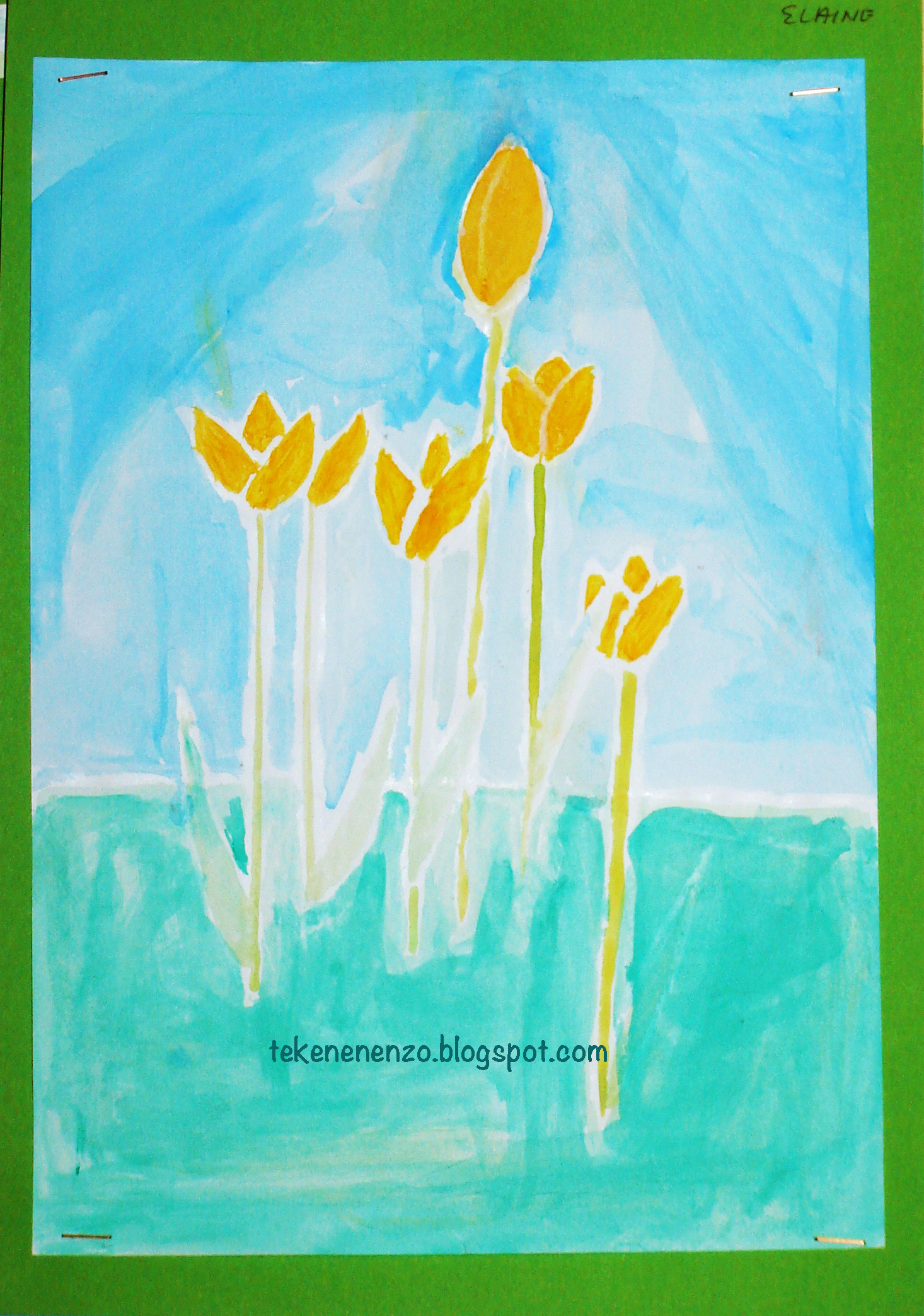
What does a tulip look like? What can you tell about the stem and the leaves? What do the petals look like? 
Every group gets a vase with some tulips. Students todraw a horizon line about a third from the bottom. 
Draw tulips with a white crayon. Look carefully at the tulips in the vase. The tulips must overlap.
Colour them with water paint, the white lines will remain. Paint the lawn and the air. Stick the artwork on a colored background.


Sunday, August 14, 2022

Landscape like Ton Schulten


You need:

  1. drawing sheet 
  2. tempera paint in primary colors, black and white  
  3. ruler
  4. pencil
  5. brushes
Ton Schulten (1938) is a Dutch painter, born and living in the small town Ootmarsum. He worked as a graphic designer and decided in 1989 to devote himself entirely to painting. His main source of inspiration is the landscape of Twente, a region in the east of Holland. This is a semi-open landscape that, due to the planting of hedges and wooded banks, looks like a stage with wings.  

Show artworks from Ton Schulten and discuss them.
  • Schulten's use of colors  
  • horizon line
  • the 'curtains' on the sides - the picture is darker there than in the middle
  • simple shapes
  • divided in rectangles
by students of grade 6

What should you do? 
You're going to draw a landscape like Ton Schulten. First draw a horizon line on about half of the sheet. Draw one or some simple houses. Then draw some draw trees. Divide the drawing with horizontal and vertical lines into small rectangles.  
Paint the rectangles with tempera. Mix your own colors, starting with the brightest one. For example: start with white and add a drop of blue to get light blue; add more drops to get a darker blue.  
Perhaps you can draw 'curtains', just like Ton Schulten: the sides are darker than those in the center. 

Elements of art: shape, line, color, nuance.  

Wednesday, April 28, 2021

On Monet's bridge


You need: 

  1. drawing sheet A3 size
  2. tempera paint
  3. brushes
  4. white construction paper
  5. scissors
  6. oilpastels
  7. glue
Claude Monet (1840-1926) is considered one of the most important painters of Impressionism. 

 Typical for Impressionists:

  • they choose subjects from ordinary life 
  • special attention for light and color
  • work in the open air
  • smooth brushstrokes
  • dashes resemble a sketch
  • it's about the impression!
Discuss the term impressionism. Show some paintings by Monet and zoom in on a work with water lilies in Arts & Culture. Do students see the characteristics of impressionism in this artwork?

Monet had a large garden with a pond and a Japanese bridge in Giverny France. He liked to paint in that garden. His works of water lilies are therefore famous and are the basis of this lesson.


Lesson 1
Draw a horizon line above the middle of your sheet. Paint the pond and the sky with short brush strokes, like Monet did. Do not mix the paint, but take two colors on your brush.  Make sure the blue color of the pond is not the same color as the sky.
Paint trees on both sides of the sheet in the same way. Paint water lilies in the pond. Be sure that they are larger in the front of the pond than in the back.  

Lesson 2
Have someone take a picture of you that shows you all the way. Print the photo and cut it out. 
Cut three parallel arcs from about 1,5 cm wide from the construction paper.  Then cut four straight pieces of 1,5 cm wide. Paste the photo on the work and paste the bridge over it. 

All artworks are made by students of grade 6

Source: MaryMaking.blogspot.com

Thursday, April 1, 2021

Paint like an impressionist


This lesson is an exercise for painting an impressionist work.

What do you need?
  • white drawing sheet
  • tempera paint in red, blue and yellow
  • small brushes
  • paper towels
Instruction
View impressionist paintings, for example from Claude Monet or Van Gogh. Zoom into Starry Night from Van Gogh using this link
What do you see?
  • the painting is made out with loose dashes.   
  • the dashes indicate a direction or movement, they are not just placed.
  • you can see the canvas between the dashes. The color of the canvas is therefore part of the painting. 
View a sunset picture. You see the sun reflected in the water and the sun's rays point left, up and right. 

Exercise before you get started: 
  • Practice painting short dashes on a scrap. To do this, always lift the brush from the paper.
  • Practice with two colors on your brush; do not mix!
  • Make narrow/wide dashes by turning/not turning your brush.
  • Clean the brush with a paper towel for a new color, do not use water!
What should you do? 
  1. Fold the sheet in half lengthwise, this is the horizon line.
  2. Draw a semi circle on the horizon line: the sun.
  3. Paint the sun. Apply red and yellow to your brush. Do not mix!
  4. Paint the sun's rays with yellow and very little red. Put something on your brush of both colors and make short strokes by lifting the brush from the paper each time. Leave a bit of white between the strokes.
  5. Make the reflection of the sun in the water. The direction of the brushstrokes must be horizontal now, just like the water.
  6. Paint the sky with blue and white (add two colors to the brush). Use white to make a lighter blue. Follow the direction of the sun's rays. Leave again a bit of white between the strokes.
  7. Paint the sea with blue, white (and maybe green). Do not mix! The direction is horizontal here. Think of the white space between the lines.
Elements of art: line, color, nuance.

Thursday, October 29, 2020

Still life with fruit

door leerlingen van groep 5

You need:
  1. corrugated cardboard
  2. scissors
  3. white drawing sheet
  4. tempera paint
  5. brush
  6. glue
  7. colored construction paper
Vies and discuss still lifes of fruit in different styles (for example Caravaggio and Cezanne). How is the fruit arranged? Why at that way? Which parts are light and which parts are dark? What does that mean? 


Provide each group of students with a bowl of different fruit types. Students paint the fruits (no drawing first!) after a good observation. 
Cut a fruit bowl out of the cardboard. Cut out the fruits with a small white edge. Stick the fruits on a colored sheet, be sure to let them overlap each other. Stick the cardboard bowl. Some fruits will partly disappear in it. 

Elements of art: space, color, value. 

Wednesday, August 12, 2020

Life-size Keith Haring groupwork


Show Haring's works and discuss them: 
  • comic like people
  • few details
  • thick black outlines
  • bright colors
  • dashes that indicate movement 
You need:
  1. life-size drawing sheets.
  2. tempera paint
  3. brushes grote vellen schetspapier 
Paste drawing sheets together. There must fit a child on it. 
Make groups of 4 students. Trace one student of each group using a black marker.


 Students paint the traced figure in one color. Fill the rest of the sheet with patterns in black paint.