Showing posts with label grade 1. Show all posts

Wednesday, January 7, 2026

Winter mittens and cap

What do you need?
  • colored construction paper
  • markers
  • white sheet
  • glue
  • scissors
  • oil pastel
What should you do?
  1. Draw a face and color it with oil pastels. Be sure the eyes are not on top of the head, but in the middle. The space between the two eyes is as wide as an eye.
  2. Cut mittens and a hat from colored paper (or trace templates first and cut them). 
  3. Draw patterns on hat and mittens with a marker. The patterns on both mittens should be similar, as well as the patterns on the hat.
  4. Paste hat and mittens on the drawing. Make sure the thumbs point to each other!
Drawings made by students of grade 2. 

Friday, December 5, 2025

Christmas trees in the snow

What do you need?
  • large drawing sheets 
  • liquid watercolor green and red 
  • oilpastel crayons 
  • brushes
What should you do ?
  • Draw a wavy line, the ground. 
  • Draw several christmas trees. Simple triangles are okay. 
  • Do not draw all the trees next to each other, but let them overlap. 
  • Decorate the trees with balls and garlands.
  • Draw presents under the trees. 
  • Color with oil pastels, but leave the ground white. 
  • Use white oilpastel for snowflakes.
  • Paint with liquid watercolor, the ground has to stay white.
Works of art made by students of grade 1.
Elements of art: color, shape, space.

Saturday, November 1, 2025

Autumn birches

What do you need?

  • drawing sheets *
  • painters tape in several widths
  • liquid watercolor paint in red, green and yellow 
  • brushes
  • tempera paint  
  • stencil brush
  • old shopping card/customer card
  • saucers and jars
* Choose thick drawing paper, to avoid ripping when you remove the tape . 

Before:
Look at birch trees. What do you see?   
 

  • straight white trunks
  • horizontal peeling bark
  • autumn color leaves: orange, yellow, brown, red
What to do?
Step 1
Place the sheet on the table with the narrow site down. Stick strips of tape from top to bottom. Wide for the trunks, narrower for the branches. Note: branches grow up! 
Step 2
Paint the background in strips with diluted liquid watercolor. Let dry. Peel off the tape carefully. 
Step 3
Put some black tempera paint on a saucer. Dip a customer card in it. Pull this in several places from left to right (or right to left!) to halfway up the trunk to make the black streaks.
Step 4
Spray some warm colors tempera + green on a saucer.  Stamp leaves at the top of the trees using the stencil brush. Do not mix colors, but use several colors at the brush at the same time. 

Step 5
Hang up! 

Works of art made by students of grade 1. 

Sunday, September 21, 2025

It's warm blanket time!

What do you need?
  • colored paper for background
  • brown paper 
  • leftovers of colored and white paper 
  • square white paper
  • watercolor paint + brushes
  • crayons
  • black marker
  • scissors and glue
Before
Divide this lesson over more moments. Consider in advance whether you will give students a template of the bear's head or whether they' ll have to draw it themselves. 
What should you do?

Folding and painting: 
  1. For the blanket: fold the white sheet into16 squares. 
  2. Paint each square in a different color. 
  3. Let dry. 
  4. Draw stripes with a crayon on the folds of the squares like on a patchwork blanket. 

Cutting:
  1. Draw a bear's head on brown paper and cut out (or trace the template and cut out)
  2. Legs: cut four ovals out of brown paper. 
  3. Snout: cut a circle out of colored paper. 
  4. Ears: cut two half circles out of colored paper. 
  5. Eyes: cut two small circles out of white paper. 
Pasting and drawing:
  1. Stick the hind legs on the colored sheet. 
  2. Stick the blanket so that legs come out from underneath.
  3. Stick the head halfway on the blanket and the front legs underneath.  
  4. Stick snout, eyes and ears on the head.
  5. Draw nose, whiskers and pupils with a black marker. 
Works of art made by students of grade 1.  


Sunday, August 31, 2025

Cat and bird, like Paul Klee

Paul Klee (1879 – 1940) is a German/Swiss artist. His work straddles the line between figurative and abstract. Klee painted landscapes, portraits, animals, mythology, mysterious machines. Does his work belong to cubism, expressionism or surrealism? He brought something from every art movement. Klee looked for patterns and motifs in all kind of art styles: African art, Islamic decorations, clothing and also form children's drawings. Klee left behind more than 9000 works of art.  

undefined
Cat and bird, Paul Klee, 1928
What do you need?
  • drawing sheet
  • pencil
  • black marker
  • watercolor paint
  • pencils
What do you see?
Discuss Klee's painting Cat and bird. 
  • the head of a cat with a bird above his eyes. What would this mean? Does the cat dream of its prey? 
  • left side of the head is wider than the right side
  • large eyes with vertical pupils
  • one eye is larger than the other
  • warm colors, except the eyes
  • bright pink nose in the shape of a heart

What should you do?  
Step 1: Fold the sheet in four. Scetch a W. 

Step 2: Put a dot on the fold and and draw a slightly curving line to it from both sides: the top of the head.  

Step 3: Continue the lines from step 2 downwards.  

Step 4: Draw the eyes from the center to the  side. Draw pupils.  

Step 5: Draw nose, whiskers and the little bird.  

Step 6: Color cat and background using water color paint. Trace the outlines with a black marker.  

Drawings made by students of grade 1, 2 and 3. 
Step by step idea: Blowing Rock Museum, NC. 

Wednesday, July 17, 2024

Stamping with Mondrian


Goal: reducing the visible world in horizontal and vertical lines and primary colors.   
Technique: stamping. 

What do you need?
  • black cardboard 
  • sponges cut in different sizes (squares and rectangles) 
  • tempera paint in red, blue and yellow 
  • brushes
  • white crayons 
About the artist
View these artworks of Mondrian and talk about how he abstracted a tree. 

Also talk about Victory Boogie Woogie, the painting in which you can see part of the map of New York. Tell students we are going to make our own Mondrian map. Discuss the terms primary colors, square, rectangle, vertical and horizontal lines.


Instruction 
Brushes will not be rinsed, but will remain the same color.
Show how to use a brush to rub the sponge with paint. 
Show how to stamp: do not slide the sponge, but lift it off the paper. This way you'll get a tight shape.  
Stamp horizontally or vertically only. 
Do not stamp two of the same colors next to each other. 
Make sure the shapes don't touch each other. You must be able to see the black roads between them. 

When the work is dry, draw stripes on the black roads using a white crayon. 

Artworks are made by students of grade 1/2. 

Saturday, June 15, 2024

Monet's waterlilies pond

What do you need?

  • drawing paper A3 size
  • tempera paint in green, blue, white, red and yellow
  • two brushes per student
  • two spunges per student
  • paper towels
  • oil pastel crayons 
  • saucers 
About the artist
Claude Monet (1840-1926) is considered one of the most important painters of Impressionism. Typical for Impressionists:

  • they choose subjects from ordinary life 
  • special attention for light and color
  • work in the open air
  • smooth brushstrokes
  • dashes resemble a sketch
  • it's about the impression!
Discuss the term impressionism. Show some paintings by Monet and zoom in on a work with water lilies in Arts & Culture. Do students see the characteristics of impressionism in this artwork?

Monet had a large garden with a pond and a Japanese bridge in Giverny France. He liked to paint in that garden. His works of water lilies are therefore famous and are the basis of this lesson.

What should you do?
Lesson 1
  1. Squeeze blue, green and white paint onto a saucer. 
  2. Dip your sponge into the blue paint. Stamp on the sheet. 
  3. Do the same with green paint and stamp all over the sheet. 
  4. Finally do this with white. You can use the green side of your sponge,  to get a light green color also. 
  5. Let the work dry.
Lesson 2
  1. To paint the water lilies: mix a little bit of red with white paint. Paint ovals spread across the sheet. Not too neat, it's all about impression!
  2. Paint a green border at the bottom of the ovals: the leaf. To make it fresher, you can mix some light green paint. You don't have to clean the green brush first. 
  3. Paint a yellow heart in the flowers. 
  4. Let the work dry. 
  5. Finally draw lines in your lily with a dark red or purple oil pastel: the petals. 
Artworks made by students of grade 1 and 2.

Tuesday, May 30, 2023

A lesson in color theory

What do you need?

  • 4 cards of drawing paper, 10 by 7 cm
  • pencil
  • ruler
  • markers of color pencils 
  • black construction paper
Instruction
Discuss the words primary and secundary colors using the color wheel.  
What are primary colors and why are they called so? What are secondary colors, how do you make them and why are they called so? What are the neutral colors? Explain also the word nuance

What should you do?
  1. Draw a frame on the cards at 2 mm from the edge using a thin black marker.
  2. Draw a pattern of your choice on each card.
  3. Color the cards according to the terms discussed.
  4. Outline the patterns with a thin black marker.
  5. Stick the cards on a black background.
  6. Add the learned words.

Thursday, September 15, 2022

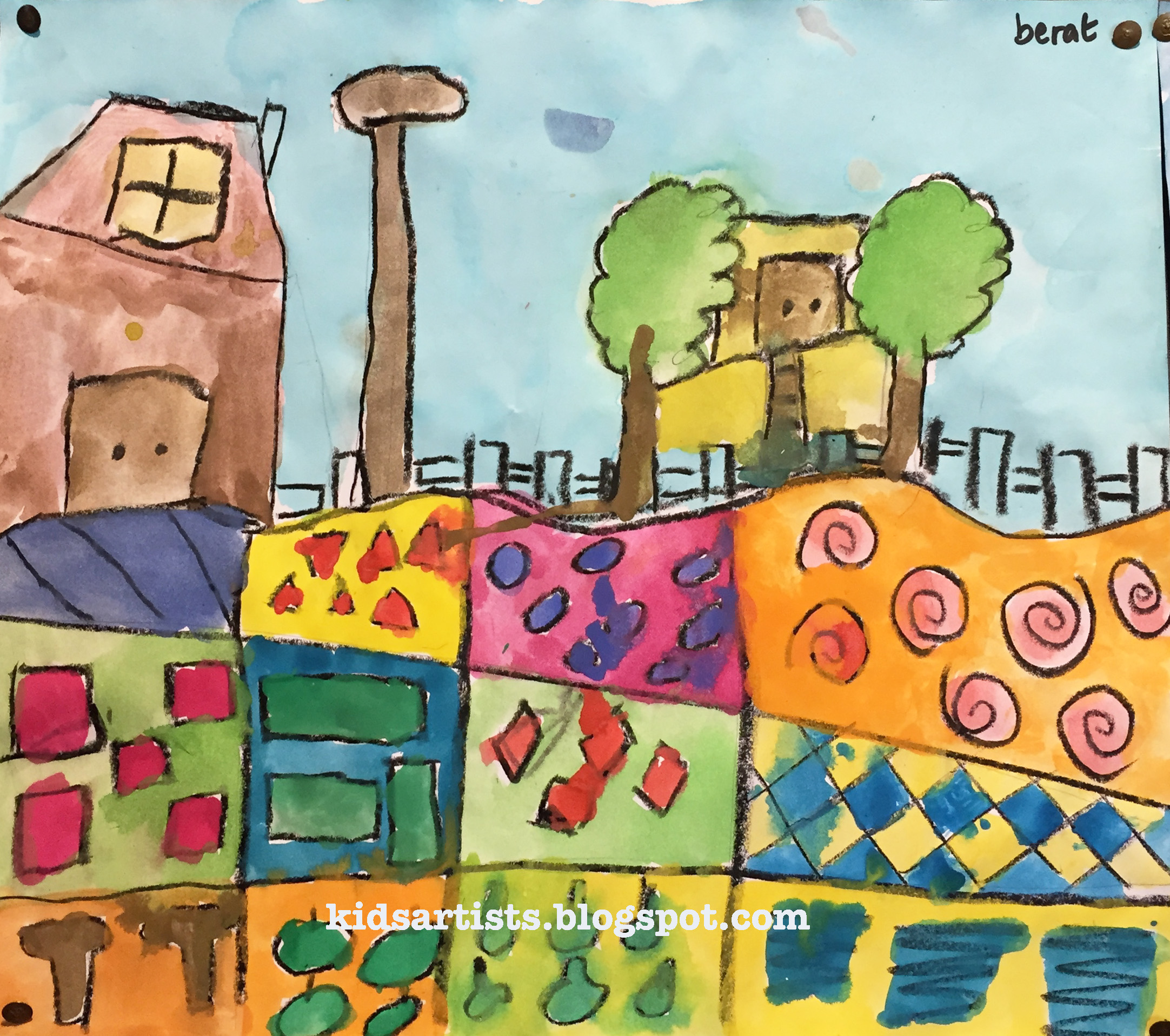
Patchwork landscape

by a student of grade 4
 You need:

  1. white drawing sheets
  2. water color paint
  3. brushes
  4. jar with water
  5. crayons
Steps:
  1.  Put the sheet in width for you.
  2.  Draw a wavy line on 2/3 of the bottom using a crayon.
  3. Divide this area in 12 of 15 surfaces by drawing 2 horizontal and 3 o4 r vertical lines. 
  4. Draw with a crayon house and trees on the horizon line.
  5. Draw patterns in the surfaces.
  6. Paint the surfaces in differtent colors.  
  7. Paint house, trees and  air. 
With this lesson you can also practice one-point perspective. Place a dot in the middle from the top of the sheet and draw vertical lines towards this dot. 


bij a student of grade 4


Wednesday, September 14, 2022

Robots rule

 You need:

  1. drawing sheets
  2. pencil
  3. markers
  4. water color paint
  5. brush 
  6. jar with water
  7. chalk pastels 


Draw a robot. Trace all pencil lines with a black marker. Color the drawing with markers, except the parts that should become metallic look. 
Paint the body of the robot grey (metallic) with water color paint. 
Let dry and color the background with chalk pastels. 


by students of grade 3


Thursday, July 8, 2021

Fun flowers


What do you need?
  • white or colored drawing sheet
  • scraps of colored paper 
  • scissors
  • glue
  • black markers

What should you do?

  1. Cut several circles from scraps of colored paper and paste them om the sheet. 
  2. Paste smaller circles on the bigger ones. 
  3. Draw petals using black markers in several thicknesses.   

Source: Krokotak.com

Saturday, April 3, 2021

Water lilies on a plate


By a student of grade 1

Claude Monet (1840-1926) is considered one of the most important painters of Impressionism. 

 Typical for Impressionists:

  • they choose subjects from ordinary life 
  • special attention for light and color
  • work in the open air
  • smooth brushstrokes
  • dashes resemble a sketch
  • it's about the impression!

Monet had a large garden with a pond and a Japanese bridge in Giverny France. He liked to paint in that garden. His works of water lilies are therefore famous.

Discuss the term impressionism. Show some paintings by Monet and zoom in on a work with water lilies in Arts & Culture. Do students see the characteristics of impressionism in this artwork?

You need:
  1. paper plates
  2. tempera paint in blue and white 
  3. stencil brush
  4. white drawing sheet 
  5. tissue paper in green an light green 
  6. water and sponge
  7. tissue paper in pink and yellow
  8. mold of a water lily leaf
  9. glue
  10. scissors
Step 1:
Dab the plate with blue and white.  


Step 2:
Wet the white paper with a sponge. Cut squares from the green tissue paper. Place them on the wet paper and let the bleed. Let dry.


Step 3
Remove the tissue paper. Trace the mold of the lilyflower leaf and cut it out.  


Step 4
Fold the tissuepaper for the lily twice diagonally. Cut a flower shape. 


Step 5
Grab the flower shapes in the middle. Crumple them into a flower. Put a drop of glue on the lily leaf and stick the center of the lily on top. Roll a wad of leftover tissue paper and stick it in the center of the flower.

Elements of art: texture, color, space. 

Sunday, November 8, 2020

Same insect - different colors


made by student of grade 1

You need:
  1. drawing sheets A5 size
  2. crayons
  3. liquid watercolor paint 
  4. brush
Draw two the same insects and color them with crayons: one with cool colors, the other with warm colors. 
Paint the background with dilluted watercolor paint: warm colors for the 'warm' insect, cool colors for the 'cool' insect. 


Element of art: color.

Thursday, October 22, 2020

Keith Haring figures on tissue paper

What do you need?
  1. colored tissuepaper
  2. white drawing sheet
  3. jar with water
  4. brush
  5. scissors
  6. templates of Haring figures
  7. pencil
  8. black marker
What should you do?
  1. Choose 2 or 3 colors of tissuepaper. Fold them in 16 squares. Cut out. 
  2. Take a drawing sheet and wet it with a brush and water. 
  3. Lay the pieces of tissue paper on the wet sheet and see how they bleed. Fill the whole sheet and be sure to use enough water. 
  4. Let dry and remove the tissue paper. 
  5. Cut two or more Haring templates and outline them with a pencil. 
  6. Trace the lines with black marker and trace them again to make nice bold lines. 
Works of art made by students of grade 3.