Friday, August 15, 2025

The vase of Kandinsky

What do you need?

  • colored cardboard A3 size
  • sponges
  • paint rollers 
  • strips of ribbed cardboard
  • bubble wrap
  • tempera paint
  • brushes
  • scissors  
  • glue
Read here about Kandinsky's concentred circles. 

Organisation
Divide this lesson in two moments. For lesson 1 (step 1-4) create four table groups where students can print. Divide students among these four groups. When someone is ready, he can go to the next group. In this way students rotate between the groups. In lesson 2 (step 5) the individual parts are combined into a work of art and students sit in their own place in the classroom.  

Group A: printing with sponges. One sponge per color. Some paper plates with tempera paint and a paint roller on each plate. 

Group B: printing with cardboard. Lay out cardboard strips  about the width of a ruler. Spray s few colors of tempera paint on paper plates. Students smear the head side of the cardboard with a brush, see picture. 

Group C: printing with bubble wrap. Lay out A4 drawing sheets and pieces of bubble wrat. Students roll in the bubble wrap with a paint roller and print it on a sheet. 

Group D: painting concentric circles. Place thick drawing paper, tempera paint and paper plates here. 

What should you do? 
Step 1: Place the cardboard upright in front of you. Stamp approximately 1/3 of the bottom full with a sponge and paint. Don't rub, stamp!  

Step 2: Stamp with the cardboard strips horizontal and vertical stripes above the sponge strips. 


Step 3: Use a paint roller to roll a piece of bubble plastic with tempera paint and print it on a white sheet. Let dry. 


Step 4: Fold a white A4 sheet into 6 squares. Paint 6 different concentric circles in each square like Kandinsky did. Each circle has 3 colors. Let dry.  


Step 5: Cut the circles. Draw a symmetric vase on the back side of the bubble plastic print and cut out. Paste vase and flowers on the colored cardboard. 

Works of art made by students of grade 3.
 

Thursday, August 14, 2025

A day at the beach

What do you need?
  • drawing sheet 
  • white drawing sheets
  • tempera paint
  • brushes
  • scissors
  • markers and/or pencils
  • glue
Before
Talk about a day at the beach: things (to do) on the sand, things (to do) in the water and things (to do) in the air. Talk about people standing in the water: they seem to have half legs!

Cover four tables with newspaper and put three containers with paint on it:
  • yellow and a little brown besides (beach) + two big brushes
  • blue and a little green (seawater) + two big brushes
  • blue and white (air) + two big brushes 
  • white (surf) + two brushes to stamp
Instruction
Show how to paint the beach: a lot of yellow on the brush and a little brown for the beach (do not mix!). Do the same with blue and white for the air, and blue with green for the sea. Make wavy motions with the brush to accentuate the water. Finish with a white stamping brush for the surf.
While four students are painting, the others can start with the drawing part of this lesson

What should you do?
  1. Paint the beach and let dry. 
  2. Draw people and things you see on the beach.
  3. Color with markers or color pencils.
  4. Cut your drawings and paste them on the beach, in the water or the air.
Artworks made by students of grade 5.

Sunday, October 6, 2024

Pumpkin, like Burton Morris


 What do you need?

  • several colors construction paper
  • black cardboard 20 by 20 cm
  • colored cardboard 20 by 20 cm
  • scissors
  • glue
  • black marker
About the artist
Burton Morris (Pittsburgh, 1964) is an American pop-art artist. He is influenced by pop-art artists from the 60's and 70's, like Warhol, Lichtenstein and Haring. Now he is one of the most famous modern post pop-art artist. Morris's work shows a contemporary twist to traditional pop-art. His work is cheerful, energetic and colourful. His characteristic lines with the bright colors give his work a fantastic energy. Morris's work is known of tv-series like Friends and also appears in major advertising campaigns by U.S. companies like AT & T, Pepsi and Heinz. 

Step by step description with photo's, see my other post about Burton Morris


And read the mail I got from Burton Morris when he came across my lesson of 2011: 

Dear Jacquelin,

I came across your blog and saw your student's artworks. I am truly touched that you honored my artwork in your teaching lessons and hope it was a success and inspired the children! 
I hope to show again in the Netherlands one day and feel free to keep in touch.
Your friend,
Burton Morris

Wednesday, September 25, 2024

Haunted house in the moonlight

You need:
  • white drawing sheet 
  • black construction paper
  • yellow chalk pastel
  • scissors
  • cutting knife
  • glue
  • white pencil
  • black marker
  • blue and purple tempera paint
  • sponge
  • saucer
What should you do? 
  1. Tear a strip of black paper from about 5 cm and paste it on the bottom of the white sheet: the ground. 
  2. Draw an old house on black paper and cut out. Use a cutting knife for doors and windows. 
  3. Paste the house on the white sheet. 
  4. Draw details with white pencil such as bricks, ghosts, spider webs etc.
  5. Draw details in the open windows with a black marker.
  6. Cut and paste a moon. 
  7. Outline moon and house with yellow chalk pastel and smudge the chalk outwards. 
  8. Stamp the background with a sponge and purple and blue paint. 
  9. Paste the artwork on a yellow sheet.

Sunday, September 15, 2024

Sunflowers in pieces


This lesson shows we can do more with our artworks than stick them on a colored background. Pretty scary to tear or cut your drawing, but the effect is great! 

What do you need? 

  • white drawing sheet 
  • black construction paper
  • pencil
  • oilpastels
  • liquid water color paint
  • brush
  • scissors and glue

What should you do? 

  1. Draw at least four sunflowers. Be sure three of them are over the edges.
  2. Color with oilpastels. 
  3. Paint the backgrond with liquid water color paint. 

The first drawing is torn in pieces and pasted on black paper with a bit space between them. Before tearing: check which side of the paper is best. One side gives nice white tear lines, the other side does not. 

In these two artworks black strips are pasted on the drawing, creating a window through which you look outside. 

Artworks made by students of grade 6. 

Wednesday, July 17, 2024

Stamping with Mondrian


Goal: reducing the visible world in horizontal and vertical lines and primary colors.   
Technique: stamping. 

What do you need?
  • black cardboard 
  • sponges cut in different sizes (squares and rectangles) 
  • tempera paint in red, blue and yellow 
  • brushes
  • white crayons 
About the artist
View these artworks of Mondrian and talk about how he abstracted a tree. 

Also talk about Victory Boogie Woogie, the painting in which you can see part of the map of New York. Tell students we are going to make our own Mondrian map. Discuss the terms primary colors, square, rectangle, vertical and horizontal lines.


Instruction 
Brushes will not be rinsed, but will remain the same color.
Show how to use a brush to rub the sponge with paint. 
Show how to stamp: do not slide the sponge, but lift it off the paper. This way you'll get a tight shape.  
Stamp horizontally or vertically only. 
Do not stamp two of the same colors next to each other. 
Make sure the shapes don't touch each other. You must be able to see the black roads between them. 

When the work is dry, draw stripes on the black roads using a white crayon. 

Artworks are made by students of grade 1/2. 

Saturday, June 15, 2024

Monet's waterlilies pond

What do you need?

  • drawing paper A3 size
  • tempera paint in green, blue, white, red and yellow
  • two brushes per student
  • two spunges per student
  • paper towels
  • oil pastel crayons 
  • saucers 
About the artist
Claude Monet (1840-1926) is considered one of the most important painters of Impressionism. Typical for Impressionists:

  • they choose subjects from ordinary life 
  • special attention for light and color
  • work in the open air
  • smooth brushstrokes
  • dashes resemble a sketch
  • it's about the impression!
Discuss the term impressionism. Show some paintings by Monet and zoom in on a work with water lilies in Arts & Culture. Do students see the characteristics of impressionism in this artwork?

Monet had a large garden with a pond and a Japanese bridge in Giverny France. He liked to paint in that garden. His works of water lilies are therefore famous and are the basis of this lesson.

What should you do?
Lesson 1
  1. Squeeze blue, green and white paint onto a saucer. 
  2. Dip your sponge into the blue paint. Stamp on the sheet. 
  3. Do the same with green paint and stamp all over the sheet. 
  4. Finally do this with white. You can use the green side of your sponge,  to get a light green color also. 
  5. Let the work dry.
Lesson 2
  1. To paint the water lilies: mix a little bit of red with white paint. Paint ovals spread across the sheet. Not too neat, it's all about impression!
  2. Paint a green border at the bottom of the ovals: the leaf. To make it fresher, you can mix some light green paint. You don't have to clean the green brush first. 
  3. Paint a yellow heart in the flowers. 
  4. Let the work dry. 
  5. Finally draw lines in your lily with a dark red or purple oil pastel: the petals. 
Artworks made by students of grade 1 and 2.

Tuesday, April 2, 2024

Mexican amate

What do you need?
  • brown paper bag
  • tempera paint in fluorescent colors and white
  • brushes
  • jar with water
  • black marker
  • colored paper for background
  • glue 
 
Instruction

Amate is a way of making paper, done for centuries by Mexican Indians. Amate paper is made by cooking the inner bark of various trees. At the beginning of the 20th century the Nahua Indians of Mexico started making amate paintings as a form of folk art, especially in order to exchange and sell them to tourists.
Show pictures of Mexican amate paintings. Discuss the features: birds, flowers, bright colors, black outlines and a frame with a pattern in bright colors.

What should you do?
  1. Tear the edges off the paper: use thumb and fingers of both hands and tear slowly. 
  2. Draw some birds and flowers with pencil and draw a patterned frame.
  3. Paint the drawing with fluorescent tempera. 
  4. Let dry and outline everything with a black marker. 
  5. Paste the artwork on colored construction paper.
Artworks made by students of grade 5-8. 

Thursday, March 7, 2024

Mix and match with Mondrian

What do you need?

  • white sheet 21 by 21 cm
  • black sheet 23 bij cm
  • paper strips 3 by 6 cm in yellow, red and blue
  • black squares 3 by 3 cm
  • glue

I did this lesson in grade 5, students worked in pairs. The figures are cut  before class. Per artwork you need 4 black squares and 16 colored rectangles. Students from higher groups can measure and cut the figures themselves. 

What should you do?
  1. Make a composition of 4 squares, each consisting of 4 colored rectangles and a black square in the middle. No two of the same colors next to each other!
  2. Paste the composition on the white sheet with a small edge visible around each shape. 
  3. Paste the artwork on a black sheet. 
It was a difficult task and not everyone succeeded! 

Artworks made by students of grade 3.

Tuesday, March 5, 2024

Grey, like Theo van Doesburg

What do you need?
  • white drawing sheet
  • black construction paper
  • ruler
  • charcoal
  • pencil
  • glue

About the artist
Theo van Doesburg (1883-1931) was a Dutch painter, architect and writer. He was charmed by the abstract art of Kandinsky and the cubism of Picasso. In 1917 he founded the magazine De Stijl (The Style), in which he and other artists could publish their innovative ideas. Well-known artists who also belong to De Stijl are Piet Mondrian, Bart van der Leck and Gerrit Rietveld.

Characteristics of the Stijl artists:

  • use of primary colors and non-colors 
  • horizontal and vertical lines
  • use of geometric shapes 
  • strive for balance and harmony in the artwork

Van Doesburg, Composition 12 - abstraction of a landscape, 1918

Instruction
In this lesson we discuss Van Doesburg's Composition in grey, made in 1919 and now in the Guggenheim New York. No primary colors, just black and white and everything in between.
The goal for this lesson is not to copy the work, but to practice the technique of working with charcoal. 

Look at the painting and discuss what stands out:
  • no color, only non-colors
  • geometric shapes with some rounded corners
  • suggestion of depth: some surfaces appear to rise through the use of light and dark next to each other 
  • only horizontal and vertical lines 

What should you do? 
  1. First practice drawing with charcoal on a scrap. Press hard, soft, wipe. Get to know the material this way.  
  2. Divide the sheet into rectangles using a pencil and ruler. 
  3. Color with charcoal. Make sure that lines between the rectangles are clearly visible. Create color nuances by pressing harder or softer, rubbing and wiping. 
  4. Stick the work on a black sheet. 
Artworks made by students of grade 5.

Tuesday, May 30, 2023

A lesson in color theory

What do you need?

  • 4 cards of drawing paper, 10 by 7 cm
  • pencil
  • ruler
  • markers of color pencils 
  • black construction paper
Instruction
Discuss the words primary and secundary colors using the color wheel.  
What are primary colors and why are they called so? What are secondary colors, how do you make them and why are they called so? What are the neutral colors? Explain also the word nuance

What should you do?
  1. Draw a frame on the cards at 2 mm from the edge using a thin black marker.
  2. Draw a pattern of your choice on each card.
  3. Color the cards according to the terms discussed.
  4. Outline the patterns with a thin black marker.
  5. Stick the cards on a black background.
  6. Add the learned words.

Thursday, May 25, 2023

Selfportrait like Roy Lichtenstein

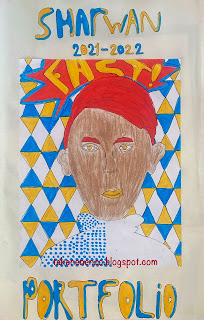
In my school we keep artwork at school until the of the school year. Students make a portfolio in june to take their work home. On front of it is a drawing in the style of one of the art movements we studied that year. 
These are the grade 6 Popart portfolio folders with a self portrait in the style of Roy Lichtenstein. 

What do you need? 
For the folder: paper A1 size, folded in half
For the drawing

  • white drawing sheet 
  • markers
  • skin color pencils 
  • fine black marker 
About the artist
Show artwork of Lichtenstein and discuss the important features: use of primary colors (sometimes with green), grid dots, black outlines, speech bubbles and slogans (onomatopoeia).

contents portfolio folder grade 6

What should you do?
  1. Draw a self portrait on the small sheet. 
  2. Add a text in a speech bubble that suits you. 
  3. Color your face using skin color pencils. Use markers for the rest of your drawing. 
  4. Fill one part of your drawing with dots. 
  5. Fill the background with a pattern. 
  6. Outline everything with a black marker. 
  7. Paste your work on the large sheet. 
  8. Draw in large letters: portfolio + your name + the school year. 


Artworks are made by students of grade 6.

    Sunday, May 21, 2023

    A field full of daisies

    What do you need?
    • white drawing sheet 
    • tempera paint in blue, green, white, yellow and red
    • brushes
    • jars with water
    • colored paper for background
    Instruction 
    1. Make your own green colors by mixing blue, white and yellow. Paint the entire sheet with small vertical strokes and let dry.
    2. Paint the daisies; in the front of they are larger  then further away. Use a small brush and a lot of paint, to make sure the grass is really covered with the paint of the flower. Use a different color green for the stalks or take the unmixed color green directly from the bottle. Paint the hearts of the flowers with big yellow blobs.
    3. Paste the artwork on a dark green background.

    Artworks made by students of grade 4 and 5. 

    Tuesday, May 2, 2023

    Prisoners in World War II


    What do you need?
    • white drawing sheet 
    • ribbed cardboard
    • pencil
    • watercolor paint
    • brushes
    • jar with water
    • black wool 
    • glue
    In Holland we remember the victims of World War II on the 4th of May. The 5th of May we celebrate the day of liberation. In schools World War II is an important part of the history lessons. 

    "We had to draw one or more people in a concentration camp. Our drawings should show the fear and powerlessness of the prisoners. Most of all did well and the artworks were really beautiful. When the drawing was finished, we had to paint it with watercolour paint, using sad colours. We used black wool to make barbed wire and pasted it in front of the drawing. Finally we pasted the artworks on ribbed cardboard. It was an intense task, and it made us really think about that terrible time."

    Artworks made by students of grade 6.

    Thursday, April 13, 2023

    Tulips; spring is coming!

    You need:
    1. a bunch of tulips
    2. vases or glasses
    3. drawing paper A4 size
    4. white crayons
    5. water paint
    6. brushes
    7. jar with water
    8. colored paper for background
    9. glue

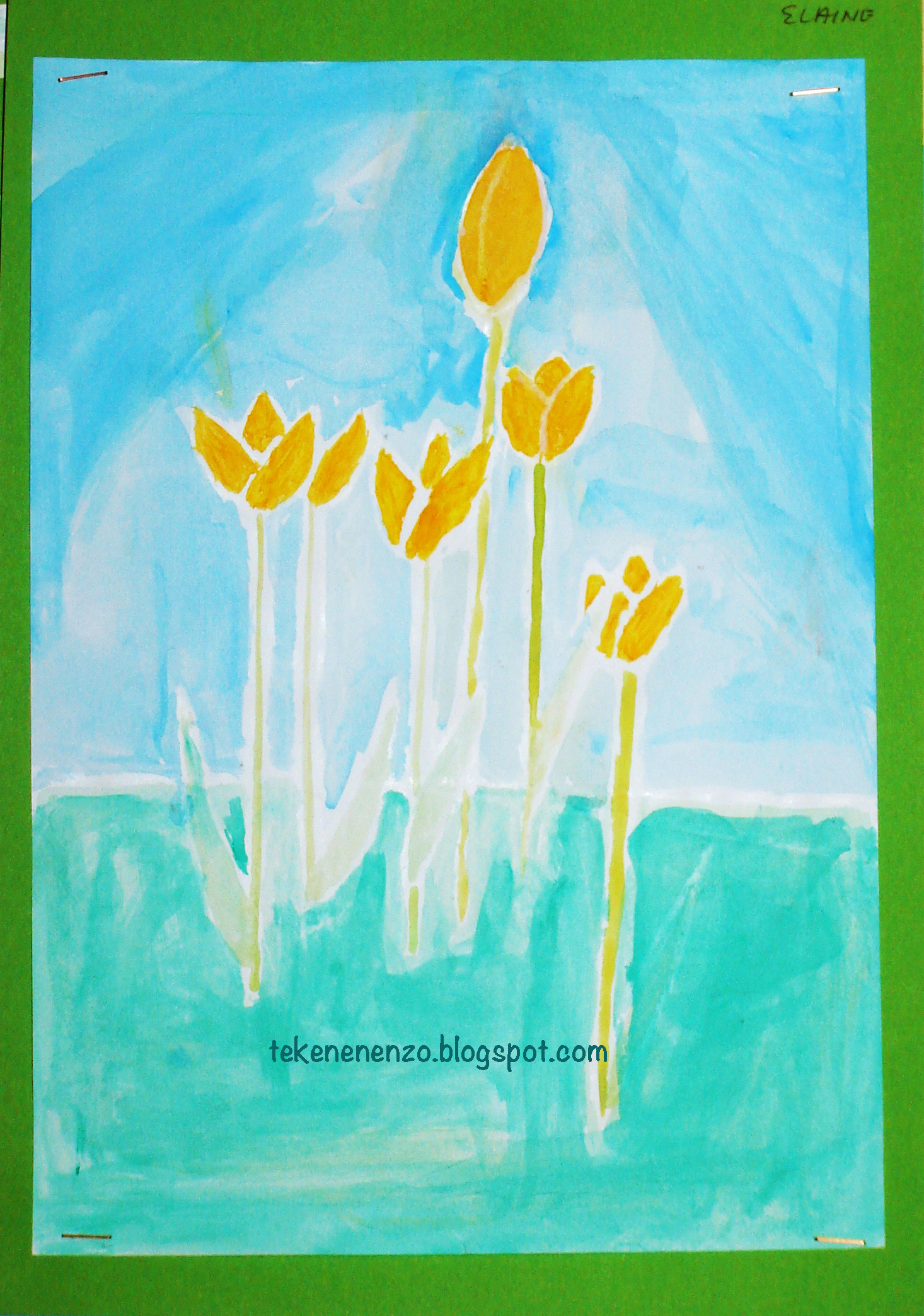
    What does a tulip look like? What can you tell about the stem and the leaves? What do the petals look like? 
    Every group gets a vase with some tulips. Students todraw a horizon line about a third from the bottom. 
    Draw tulips with a white crayon. Look carefully at the tulips in the vase. The tulips must overlap.
    Colour them with water paint, the white lines will remain. Paint the lawn and the air. Stick the artwork on a colored background.